Yefim Bronfman on Iron Chef America again

I was settling in for the evening when, on a whim, I decided to watch the latest episode of Iron Chef America.  Mind you, this is something I do very rarely these days because I don’t think the latest crop of contest-chosen alleged “iron chefs” are actually worthy of the title (Marc Forgione on the same plateau as Masaharu Morimoto??  Please).

This episode happens to feature challenger Cesare Casella going up against Jose Garces in “Battle Hawaiian Snapper” (AKA opakapaka).  I was more interested in the secret ingredient than the chefs — I love opakapaka — and was only half paying attention when they started announcing the judges, the third of which was introduced as “a Grammy award-winning musician whose piano concerts have been enjoyed by audiences all over the world:  this is Yefim Bronfman!”

Fima!  I’ve seen him in interviews, so I know that he’s got an unexpectedly dry sense of humor which would make him a fun judge.  He’s been on ICA before back in 2009, judging Michael Symon vs. former Spago executive chef Francois Kwaku-Dongo, though I had missed that episode.  A couple of his fun moments this time around:

  • Shortly after being introduced:

Yefim Bronfman:  ”What is amazing is that I think musicians and chefs have a lot in common:  I think that they work under stress, so do we; you know, they’re working strange hours like musicians do.  And also some us are prima donas, and I’m sure some chefs . . . “

Restauranteur and fellow judge Donatella Arpaia quickly interjects:  ”All of them are!  All of them!!”

  • When being introduced to one of the dishes by Chef Jose Garces:

Chef Jose Garces:  ”A scallop sausage which has a scallop and snapper mousse that has pieces of snapper folded into it, served over basically a lentil porridge at the bottom.”

Donatella Arpaia:  ”You’re confusing me — but not in a bad way.”

Yefim Bronfman:  ”I like the fact that you’re confused because it’s a sign of a true professional.  When I play music, I’m very confused.”

Overall, he was notably easier on the contestants than the other two judges, but his comments  on their dishes were generally insightful.  I was not familiar with Chef Casella before the show, and his Italian-styled take on opakapaka certainly looked interesting and appetizing.  Chef Garces took a more Asian-inspired approach, incorporating some Hawaiian ingredients without tryng to mimic Hawaiian cuisine.  They both came up with successful dishes, but without spoiling the final result for those of you who may watch the many repeat broadcasts, there was one clear winner.

As for Mr. Bronfman, he looked like he had a great time.  It was nice to see him in a different setting than normal, and I can’t wait to see him in more typical environs:  sitting at the keyboard of the Model D Steinway at Walt Disney Concert Hall playing the Bartok 3rd Piano Concerto with the Los Angeles Philharmonic in mid-October.

——————–

Photo credits:

  • Yefim Bronfman:  Dario Acosta, http://www.yefimbronfman.com
  • Iron Chef America logo:  http://www.foodnetwork.com/iron-chef-america/index.html

Classical music marketing — try it yourself, win LA Opera tickets

Just got back from a week’s vacation up in Northern California:  fun in Yosemite, Napa, and Sonoma.  I spent some quality time outdoors hiking and relaxing, not to mention tasting some very yummy wines (more on that in the near future).  Much of the week was spent unplugged and away from the internet (partially by design, partly unplanned), but now I’m back to Southern California with some solid bandwidth and a full-sized keyboard, ready to blog again. I returned to find a couple of my fellow bloggers making some pokes and jabs at a pair of local classical music marketing campaigns:

Los Angeles Opera's website creative for Cosi fan tutte

  • Brian at OutWestArts.com scoffs at the Los Angeles Philharmonic’s latest posters and their image of Gustavo Dudamel emblazoned with the slogan “Passion Forward”
  • Tim Mangan at ClassicalLife.net has some fun with Los Angeles Opera’s latest redesign of their website, especially their efforts to come up with snappy one-line slogans for their productions  (e.g., “Eugene Onegin:  from the composer of Swan Lake!“).  Tim goes on to offer some of his own hilarious suggestions for some other operas.  A must read.  Two of my favorite gems:  ”The Turn of the Screw — Sounds like porn, and it kind of is!”  and ”Rigoletto — We have a hunch you’ll like this one!”

(Special props to Diane Rhodes Bergman, VP of Marketing and Communications for LA Opera, for joining in the fun in the comments and responding to some questions from other posters.)

For their part, the LA Phil has received a certain amount of flack by those accusing them of over-hyping Gustavo Dudamel.  I blame the hero-hungry media for the eventual excessive hype, and I think the LA Phil marketing department has merely been doing their job.  In fact, the orchestra has a long history of capitalizing on the star power of their music directors — exotic and dashing Zubin Mehta, Armani-clad and fedora wearing Carlo Maria Giulini, Hollywood-connected André Previn, and the legendary bicep-baring poster of Esa-Pekka Salonen that the Los Angeles Times lamented once it disappeared.    Other cities are equally likely to celebritize their own conductors:  during Michael Tilson Thomas’s first season in San Francisco, you couldn’t turn a street corner without seeing a poster with “MTT:SFS” hanging from a lamp post; Ricardo Muti’s visage has been prevalent in Chicago this past season.

Marketing — much like music — is one of those professions done in full view of everyone else, and advertising in particular is something about which everyone is bound to have an opinion.  I  sympathize with the marketers.  It’s not easy to break through the clutter, raise awareness, and increase consideration for any product that’s trying to attract a new audience; classical music is particularly difficult given that the “product” (i.e. the music being presented) is at least 50 years old under the best of circumstances, with most popular works being 100+ years old.  What can be said about Tchaikovsky or Gounod that is truly fresh and original?  That doesn’t make it particularly commendable to call Roméo et Juliette “The World’s Most Famous Love Story” for the umpteen-millionth time, but it isn’t so horrible either.

So you think you can do it better yourself?  Here’s your chance:  LA Opera is looking for a new name for their blog, and they want help from people like you and me.  I received this email from Shannita of LA Opera in the first issue of their new e-newsletter:

New Season, New Blog and a Contest!

Welcome to the first issue of LA Opera’s new e-Newsletter. In it, we’ll take you behind the scenes of LA Opera and keep your informed on the latest company news.  We’ve also got a newly redesigned website and brand new blog where you’ll get a glimpse into what goes on behind the scenes. The only thing our blog needs is a name. That’s where you come in… We need your help naming it because the title “LA Opera Blog and News” is admittedly, rather bland. (Which is something we, and the 2011|12 Season, are not!)

Submit your title ideas to contest@laopera.com with “Name That Blog” in the subject line for a chance to win 2 tickets to Eugene Onegin performance of your choice.* Submissions will be accepted until August 31st and a winner announced on September 6th. We can’t wait to see what you come up with!

*transportation not provided

I’ve submitted a few of my own ideas (“Raking the Stage” is my personal favorite) and we’ll see if they like any of them.  Perhaps you can do better.  Good luck to us all.

Comparing guest conductors’ rehearsal styles: how to endear yourself to an orchestra — or not

To cajole or to castigate? Rafael Frühbeck de Burgos and Christoph von Dohnányi (photo credits below)

“The art of conducting lies, in my opinion, in the power of suggestion that a conductor exerts – on the audience as well as on the orchestra,” the conductor Otto Klemperer once observed. “A conductor must know how to hold attention. He must be able to lead the players with his eyes and the movements of his hands or baton. By this power of suggestion the level of a mediocre orchestra can be raised considerably. Vice versa, the playing art of a great orchestra can be lowered by a mediocre conductor.”  (Timothy Mangan, “The art of the electric baton,” The Orange County Register,  October 30, 2005)

As much as the Los Angeles Philharmonic is known for entrusting their podium to up and coming (often unproven) younger conductors, they also have a long history of balancing out that youth with old-school conductors double their age equipped with impeccable credentials:  Erich Leinsdorf led some memorable direct-to-disc recordings with the orchestra, including a Prokofiev Romeo and Juliette featuring an amazing high C played in a single take by former Principal Trumpet Robert DiVall; Kurt Sanderling began guest conducting the LA Phil in 1984, took them on a European tour after Andre Previn resigned as Music Director, and appeared as a beloved guest well into the tenure of Esa-Pekka Salonen; Pierre Boulez made frequent visits to Los Angeles through the turn of the new millenium.

Since Walt Disney Concert Hall opened in 2003, five guest conductors seem to have served most often in the role of regularly returning éminence grise (in alphabetical order):   Herbert Blomstedt, Christoph von Dohnányi, Charles Dutoit, Christoph Eschenbach, Rafael Frühbeck de Burgos.  Most musicians and classical music fans would regard all of them as being premiere conductors with the experience and resume worthy of respect in front of any orchestra.  Of course, what works for one conductor might not work with another, and similarly, a conductor that is beloved in one city could be unwelcome in another.  Resumes and reputations can only take you so far when standing on stage in front of 70+ world-class musicians, and like any relationship, the chemistry between a given conductor and a given orchestra — or lack thereof — is often hard to predict until the first downbeat is given in a rehearsal.  And rehearsal is where the sparks or the barbs will begin to fly.  I’ve seen it myself during years in various student and pick-up ensembles; at this high up the professional ladder, where the musician holding the baton and each of the ones sitting in chairs in front of him (or increasingly, her) have extensive skill, training, and ego to spare, it certainly becomes much more pointed.

Read more of this post

Quick hits on a Tuesday

  • First and foremost, many thanks to Timothy Mangan, esteemed music critic and muppet fan extraordinaire, for adding “All is Yar” to the blogroll of ClassicalLife.net.  As much as I appreciate his wry sense of humor when covering popular culture, I continue to hold out hope that the editors and publishers of the Orange County Register come to their senses and allow him to resume more regular coverage of the burgeoning OC music scene.
  • The Los Angeles Philharmonic made their latest iTunes release available for download today:  Esa-Pekka Salonen conducting the vastly under-appreciated (and lengthily titled) “Symphonic Metamorphosis on Themes of Carl Maria von Weber” and various works from Wagner operas featuring baritone Bryn Terfel.  I haven’t downloaded it yet, but I was at one of the performances at which this was recorded, and I’ve been looking forward to this finally making it online.  Freshly minted Principal Flute David Buck showed off his considerable chops in the 3rd Movement solo in the Hindemith; Mr. Terfel was at his charismatic and nuanced best, though his large voice sometimes failed to rise above the orchestra in the loudest moments of the Wagner; the Philharmonic brass sounded resplendent throughout the whole evening.  And to top it all off, it was Wagner the way I like it best:  in small chunks.  (For reference, here are reviews of the concerts from Mark Swed in the Los Angeles Times and Brian in OutWestArts.com)
  • David Bilger, Principal Trumpet of the Philadelphia Orchestra, has started his own blog, “Dave’s Mouthpiece,” on the heels of all the publicity surrounding the his appointment as Visiting Professor at the University of Georgia (my previous post on the topic HERE).  Apparently, the letter he sent to Peter Dobrin  meant to clarify the situation had the opposite effect, and as he states,  “My attempt to stop a rumor had only fueled it.”  Given his stature as a musician combined with the ongoing challenges being experienced by his orchestra, Mr. Bilger is certain to have many interesting insights to share and I look forward to following his future posts.
  • Met Futures,” a blog known for speculating about future productions at the Metropolitan Opera, has been shut down.  According to the blog’s publisher, Brad Wilber:  “For some time, I have been engaged in discussions with the Metropolitan Opera about the aggregated Met Futures content on my web site.  We have agreed that as of August 8, 2011 I will permanently dissolve my Futures list.”  Earlier today, the story was picked up by the New York Observer, who interviewed Mr. Wilber and reported that the site seems to have been killed on pressure from the Met itself.  The story goes on to discuss whether or not Mr. Wilber’s predictions were accurate (they usually were) and whether this was a worthwhile effort for the Met to undertake (they doubt it).  Read their entire report HERE.

RELATED POSTS:

Rodrigo y Gabriela (et al) at the Hollywood Bowl

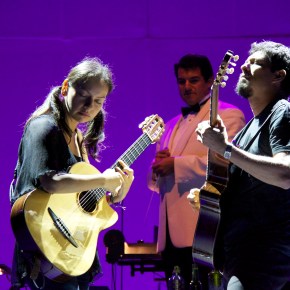
Gabriela Quintero and Rodrigo Sanchez — known together as “Rodrigo y Gabriela” — open their set at the Hollywood Bowl while conductor Miguel Harth-Bedoya looks on (photo: CK Dexter Haven)

A near-capacity crowd filled the Hollywood Bowl to the brim this past Saturday night.  Gustavo Dudamel was in the house,  along with the Los Angeles Philharmonic and some other folks.  But for once, the crowd was not really there to see The Dude.  Sure, there were a few screams of “We love you, Gustavo!” but the loudest cheers were saved for the night’s headliners:  Rodrigo y Gabriela.

I’m not going to pretend that I knew who Rodrigo y Gabriela were before Friday, let alone did I consider myself a fan.  A little bit of YouTube footage and one amazing concert later, and I am definitely now a fan and will be doing a great deal to learn more about them and their music.

Rodrigo y Gabirela (Gabriela Quintero and Rodrigo Sanchez) in a less introspective moment (photo: CK Dexter Haven)

As the story goes, Rodrigo Sanchez and Gabriela Quintero met when both were non-classically trained hard-core rockers in Mexico.  They become disenchanted with the local scene and decided to shed extraneous bandmates and instruments before ending up as an instrumental duo in, of all places, Ireland.  They survived by busking and doing small gigs until the their break led them to appearances all over Ireland and the UK.  Their eponymous 2006 release entered the Irish charts at #1, and they have not looked back since.  U.S. exposure was helped along by appearances on late night TV and a profile on MTV, among other things.  Their last appearance in Los Angeles was in 2010 when they triumphed at the Greek Theatre.

When they first stepped onto a darkened Hollywood Bowl stage on Saturday with their amplified acoustic guitars in hand, this uninitiated listener expected traditional latin-styled playing tinged with perhaps some more modern influences.  At first blush, I seemed to get what I was expecting as the pair started with “Hanuman” and “Triveni” demonstrating their usual setup:  Gabriela displays her uncanny flamenco-tinged ability to strum rhythm on the strings while simultaneously beating complex percussion on the body of the guitar, all while Rodrigo  picks lead guitar.  However, within a few minutes, it became clear that their musical sensibilities had as much in common (perhaps more) with English folk-rock stars Mumford & Sons as they did with the pop-flamenco likes of Gipsy Kings.

Read more of this post

Even eateries need their own Parsifal: Nickel Diner’s maple bacon donuts

Nickel Diner's Maple Bacon Donuts: Hide your kids, hide your wives, and hide your husbands too (photo: Kimberli Ransom Photography)

Nickel Diner is just about three years old now.  In that time, it has gone from gritty Downtown L.A. pioneer to hip Downtown L.A. legend, all while managing to stay true to its sense of both aesthetic and culinary style.  Unlike the Main Street USA located in a certain Orange County theme park, this Main Street eatery is not staffed by “cast members” who smile cheerily as you walk through the door, nor is does it open onto a sidewalk cleared of stragglers and steam-cleaned every night.  And yet, people come from all over the Southland to revel in (or brave) the still funky neighborhood to eat Monica May’s yummy take on classic diner cuisine — and to eat donuts that are hand covered in genuine maple glaze and dipped into bits of freshly cooked bacon (fast forward to about 4:06 of the video below to watch them being made).

Every legend needs a hero, and Nickel Diner became the legend of which I speak because of the heroics of these donuts.  Don’t get me wrong — success could not have come without the rest of the elements serving their vital role.  But let’s face it:  the Maple Bacon Donut is the Parsifal at Nickel Diner’s veritable Round Table of Grail Knights; it is Gloria Estefan and everything else is the Miami Sound Machine.   The donuts are so very good that when Koa Duncan brought her formidable pastry skills and resume (including stints under both Alain Giraud and Ludo Lefebvre at Bastide) to the diner in 2010, the Maple Bacon Donuts stayed — even though she used to be a vegan.  (She is now a happy carnivore)

This past week, it was my turn to bring Thursday breakfast for all the co-workers at The Day Job.  Most people bring some muffins or bagels, the more health conscious bring fruit, and a box or two of Krispy Kremes has been known to appear (and quickly disappear) on occasion.  I had mentioned Nickel Diner’s treats in the past and people laughed it off as a myth, so I knew that I was bringing The Donuts when my week came around.

Read more of this post

Philly Principal Trumpet gets teaching job in Georgia, but is staying with orchestra (for now)

David Bilger (photo: The University of Georgia)

David Bilger, Principal Trumpet of the Philadelphia Orchestra since 1995, has accepted a teaching position in Athens, GA.

In a letter sent to Peter Dobrin of the Philadelphia Inquirer, Mr. Bilger confirms that:

  •  He will immediately become the “Visiting Professor of Music and William F. and Pamela P. Prokasy Professor in the Arts at the University of Georgia.”
  • He will continue to teach at The Curtis Institute of Music and Temple University
  • He will keep his position with the Philadelphia Orchestra, but will not be playing in four subscription weeks, and will be withdrawing as soloist in the PO’s performance of Bach’s 2nd Brandenburg Concerto

The letter is quite diplomatic, yet certainly does not pull any punches with regards to Mr. Bilger’s motivation in accepting the two-year position.

Check out this excerpt:

News about many conductors; a comment about a critic, a pianist, and a dress

Jeffrey Kahane, Lionel Bringuier, Jorge Mester, and Grant Gershon

I am still trying to piece together the data for the next installment of my analysis of Gustavo Dudamel’s penchant for new music (as promised in my previous post); however, these things take time and the day job keeps getting in the way.  In the meantime, it seems like every time you turned around recently, there was news about one local conductor or another, a bit of unfortunate conductor news out of NY, and a really unfortunate set of comments about a particularly tiny dress:

First, the bad news:  The New York Times reported that George Manahan, Music Director of the New York City Opera (NYCO) since 1996, will lose his job.  In fact, NYCO is abolishing the position of Music Director entirely.  Another sad and unfortunate result of NYCO’s fiscal and artistic woes.

Now that that’s taken care of . . .

Read more of this post

Gustavo Dudamel and new music (Part One of an ongoing series)

John Adams and Gustavo Dudamel on stage at Walt Disney Concert Hall

“Gustavo Dudamel — new music conductor.”  Or perhaps, “Gustavo Dudamel — new music proponent.”

Really??

The young maestro is not necessarily known for conducting new music as much as others such as David Robertson or Kent Nagano, and he certainly does not have the reputation or gravitas that Esa-Pekka Salonen brings when conducting “new” or “newer” music.  Mr. Dudamel’s own PR machine and the press coverage that springs from it are much more likely to discuss his El Sistema roots and continued commitment to youth orchestras than they are to mention premieres he has conducted.

Despite all of this perception and talk, what is the reality?  How does Mr. Dudamel actually compare to other conductors, including his predecessor as Music Director of the Los Angeles Philharmonic?  There are many ways to look at this, and I’ll do my best to hit as many of them as possible over the course of multiple posts.

Based on points brought up during the  discussion that resulted from my last post, let’s start with the number of works conductors program with their own orchestra during the upcoming 2011-12 season.  For purposes of this discussion, we’ll call anything composed in the past 40 years as “new music.”  Here’s what I discovered:

Read more of this post

%d bloggers like this: