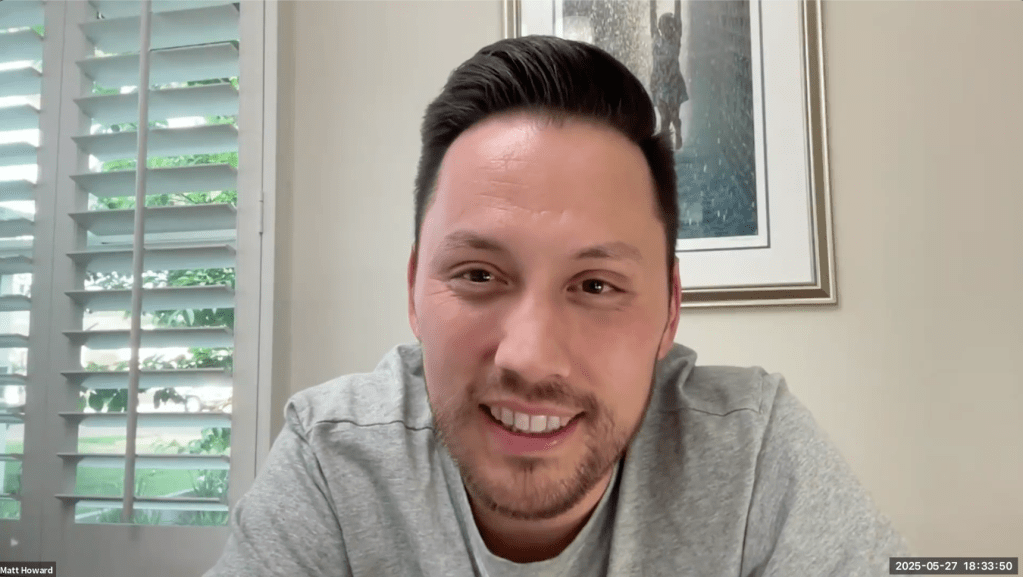
Almost all classical musicians start playing their instrument in their youth, usually when their age is still in single digits — some as young as 2-years old are bowing cardboard violins. They spend two decades refining their craft to take multiple auditions, hoping to get paid to play music. Most of them play in a school orchestra, some play in other ensembles, and almost all get to play classical music and attend their first classical music concert well before college.
Ant then there is Matthew Howard.
The percussionist did not begin playing classical music in earnest until he was in college — and not one of the country’s legendary conservatories or mighty university music schools. Mr. Howard started at a humble and underrated California community college when he caught the classical music bug.
Yet within a few short years, the Southern California native quickly landed at the USC Thornton School of Music, graduated in 2012 and went on to get a Master’s degree from the New England Conservatory (NEC), before spending one year as a fellow at the New World Symphony working with Michael Tilson Thomas. In 2016, he finally won his first audition and landed finally landed a full-time job, and it was a doozy: Principal Percussion of the Los Angeles Philharmonic.
In many ways, Mr. Howard’s story is the quintessential American dream: late bloomer from a mixed ethnic background combines, skill, hard work, and good fortune for amazing professional success.
Thursday, he played the world premiere of Naru, a percussion concerto written specifically for him by Joseph Pereira, renowned composer and LA Phil Principal Timpani, and conducted by Gustavo Gimeno, the Toronto Symphony’s Music Director. Also on the program are Bernard Herrmann’s Suite from Vertigo and Tchaikovsky’s Symphony No. 5. The program goes on the road Friday night at Segerstrom Concert Hall in Costa Mesa, hosted by the Philharmonic Society of Orange County, before returning to Walt Disney Concert Hall Saturday evening and Sunday afternoon.
I had the good pleasure to speak with Mr. Howard this past Tuesday evening as we was making final preparations for these performances. He was extremely affable, forthcoming, and generous with his time.
Much of that conversation, edited slightly for clarity and flow, will be shared here on All is Yar. Part 1 below goes over his unlikely start in music, his time at USC and the New World Symphony, his time so far as Principal Percussion of his hometown orchestra, and begins to discuss Naru. Part 2 will go deeper into Naru and a little more.
—————
CK Dexter Haven: Let’s start off with how a local boy gets an LA Phil principal job in his mid 20s. When was the 1st time you saw this orchestra perform?
Matthew Howard: Very good question. Funny. I got an extremely late start into this. The first time I actually saw the orchestra play, I think I was freshman in college. I was out in Pierce Community College, so that that would have been 2008.
CKDH: You were still a jazz drummer up until that point, right?
MH: Yeah, in 2008. That’s when I first saw them, and that means 7 years later I joined the orchestra.
CKDH: So no attending Symphony for Youth, none of that?
MH: Yep. Up until then I was in jazz bands, rock bands, you know, marching bands, that type of stuff.
CKDH: How’d you get into percussion to begin with? Did you start off like you wanted to be a drummer? Or were you like pianist violinist and then worked your way into percussion?
MH: I guess my first exposure to drums was [because] I’ve always had some kind of urge to do something rhythmical. We’d go through Guitar Center or something like that, and I’d be like, “Oh, let me go to the drum section.” I just wanted to hit stuff. I wasn’t trained or anything right.
But half of my family is Japanese. So because of that, my mom found a community Taiko group that would let me join in, and I didn’t know how to read music, didn’t know how to play any drums or anything.
It was at a church out in Culver City. We went, and I absolutely fell in love with it, the performative aspect: how showy it was, how much fun it was. All my heritage being involved with this was, I felt, a very deep connection with this.
From there, I remember in the church they had a drum set there. They would always say, “Don’t go over and play that drum set!” So, I had to go: just tap it a couple of times, you know? I mean, it was just sitting there (laughs). So because of that, my mom was like, “Oh, you like drum set, let’s get you a couple of drum set lessons.” And so in high school, I started taking some drum set lessons.
That’s how I started. My only other musical background was when I was in elementary school, I took some very, very beginner piano lessons. That’s about it.
CKDH: Wow: late start, but pretty rapid rise. So you’re at Pierce, you see the LA Phil, and is that when you got the classical music bug? Tell me how that happened.
MH: Yeah. When I was in middle school and high school, I was very sports focused. I really wanted to go all the way with some type of sport, and I was dabbling in everything from football, baseball, racquetball. I was just trying to just do a lot of things like that. Some basketball—of course, I’m 5’10” and I’m not very quick, so didn’t have a lot of longevity in that field.
Definitely baseball was something that I really enjoyed. But then I ended up injuring myself my arm and the doctor said I couldn’t do sports anymore, at least baseball. Because of that, I gotta think about getting serious about doing something to make money. I can join my dad and be a construction worker, but I decided, no, let me try something else.
I decided at Pierce College my freshman year that I wanted to do music. I got really, really serious with this, and for people that know me, I tend to have a really obsessive personality when it comes to things I really enjoy—just going in the weeds and figuring things out, and I find it really fascinating, really fun. I would wheel a marimba out into that parking lot of Pierce College in the 115 degree heat over the summer, I would practice, and I would study.
My first teacher ever was Jon Magnussen, and he taught at CSUN, and I would go over to his house every week, and I would learn the scales, all of that stuff. It was great to just go out there and learn everything, [especially] the snare drum, and learn about all that.
So that’s kind of how I got introduced into percussion. Of course, in high school, when I was doing the marching band, they were like, “Oh, go back there and hit those things back there.” I had no idea what I was doing, but I would like hit timpani and stuff like that. I wouldn’t consider that real, you know.
CKDH: You may not have seen, but I had actually interviewed Raynor Carroll (the previous LA Phil Principal Percussion) right as he was about to retire. He had mentioned how you were probably the most well-prepared of anybody who we ever taught going into it, and that you were basically “obsessed,” to use your word about all of that.
So at some point, you decide you’re going to transfer out and you end up at USC Thornton School of Music. Tell me about that transition, and when you decided that that was going to be a thing.
MH: While I was at Pierce, I took a couple lessons with Raynor, so my thought was that I wanted to actually transfer and go to UCLA because he had taught there and because my mom went to UCLA. Pierce has a great transfer rate going to UCLA. So after 2 years [at Pierce] I would have transferred there.
But I actually found another big thing of mine: if I wanted to go really, really hard into music, it made the most sense to find the best people in LA and invest in my teaching upfront, not just try to find someone to just help me along on the way. No, I wanted to learn from the best, and I wanted to be able to just get there as fast as possible as I already had a late start.
So I reached out to someone named Judy Chilnick, who is actually coming to one of my shows. I still keep in touch with her. To this day she is incredible, and after the 1st lesson I told her, yeah, I mean, I want to transfer somewhere for college. And she was like, “Have you thought about USC?” And I said, “No, I haven’t. I was actually thinking at the rival school.” (laughs).
On the spot, she said, “Hang on one sec.” She calls the instructor there, Erik Forrester, and sets up a private audition for the upcoming year. And so I talked with him, and within a couple of weeks I go there play some stuff for him, and he admits me for the next year. Wow!
That was an incredible, you know. Judy changed my life. All these little things along the way have really got me to this point, and I will never forget those moments. But yeah, that’s how I end up at USC. Life changing.
CKDH: And so you were at Pierce for one year before you transferred to USC. Then after one year there, Joe (Pereira) and Jim Babor take over the percussion department.
MH: Right, Erik left, and then Jim and Joe took over.
CKDH: So you’ve been trying to study with the best in LA. And now you’re being taught by members of the section of the big local band. How was it different studying with them versus Erik when you started in the program?
MH: They all have their own versions of how to prepare like you have. Perry Dreiman (retired LA Phil percussionist), for instance, who’s a very insanely talented musician. Very much old school when it comes to teaching a lot of this core rep. Amazing things to say.
Then you have Jim [Babor], who’s also a little bit old school, but is very structured, has a lot of written out exercises. We used to actually—funny enough, I don’t know if he knows this—we used to call him “Dr. J” back in the day, because, well, he would always give you the cure for whatever ails you?! (laughs)
Of course, Raynor, with his vast knowledge of all the rep and just being in his position and just hearing about, you know all the intricacies that go in with that, and giving me all because he would play those principal parts. So it’d be really cool to tap his brain for all of that.
And then, Joe [Pereira], who is just like this musical phenom, who wears every single hat you can think of. Speaking of obsessive: he’s another one of those who just loves obsessing over every detail, and it shows in like the beauty and the craft.
So that’s the all 4 of them, you know. They give something different.
CKDH: That’s awesome. Obviously, you decided to go pretty hardcore into this within a relatively short period of time. A lot of people who go to school at fine conservatories like Thornton [and NEC] end up at great places like New World Symphony, right? And by the time you’re at New World, most of the people who end up there are going to get jobs in professional orchestras.
When did you know that you could actually make a living at this? Because there are a lot of people who went to fancy schools who aren’t professional musicians and aren’t making a living as a musician, let alone with the kind of job that you have.
MH: Yeah. Well, you know, I actually did not know I was gonna make a living at this. I actually had a deadline for myself. Like, if I didn’t get a job by—I don’t know, late twenties, or when I hit 30 or something like that—I would pivot and go into a trade or something like that. I had no idea what I was going to do. I know that’s another question that people tend to ask me. I have no idea what I would do if it wasn’t for music. It was just one of those things where all of the stars aligned, and I ended up getting this incredible job.
The New World scene was actually, very, very crucial, because you’re surrounded by all these people that are winning jobs. You can ask any musician out there: yes, you can have some successes, either winning some smaller jobs or not winning any small jobs and advancing a lot. But you never fully know how you were going to stack up with that with the field that day in that orchestra like it’s always changing.
You know that’s one of the beauties of this, and it’s one of the another thing that I obsessed with is, you know, I couldn’t do sports anymore. But to me this is now became my new sport, you know. So I absolutely love the competitive nature of this. I loved testing my skills. I loved falling on my face and knowing that I’d get right back up and fix those mistakes for next time.
Yeah, I just loved everything about that, where a lot of people, I feel, shied away.
CKDH: How many auditions did you take for jobs after New World?
MH: That’s a very good question. I think I was actually trying to count earlier today. But I think it’s 8. Actually might be on the low side.
CKDH: Yeah, that seems low.
MH: I know a lot of people that have taken, like, 40 auditions.
There’s a disclaimer to all this: luck is a factor. But you know, I did work really, really hard; a lot of people work really, really hard. But yes, luck is a factor in this; I will be the first one to admit that.
CKDH: Did you get offers out of those other 7?
MH: No, I made it to the finals for Colorado and you know some other jobs out there. But no.
CKDH: So, with that track record, combined with this obsessive, highly competitive nature, Raynor retires and the big job at the local band opens up, and you decide you’re going to throw your hat in the ring.
Tell me about that whole mindset. Are you so competitive that you were like, “Well, of course, I’m getting this job. This is totally my job to win!” Or was it just, “I’m pretty good, let’s give it a shot.” If those are the extremes, where was it for you on that spectrum?
MH: Well, funny enough . . . I really enjoyed giving out Christmas candy to people. I knew the LA Phil section, they’re some of my old teachers. I would just go around and just give some small things of See’s candy to people just to keep in touch and see how their holidays going, and just to give them something special.
I remember being at Perry Dreiman’s house, and I was giving him candy, and he was like, “Oh, thanks for the gift! Just so, you know, we maybe are going to have an opening coming up in the spring.” And I said, “Um, hold that thought, I’ll be right back. I’m going to go practice.” So I immediately went and started practicing.
Now as far as my whole mindset, whether I could compete and win this or not: I actually spent a pretty fair amount of time at the New World Symphony, going very, very deep into mindset and mental game. Kind of honing that side. I felt like that was actually a very, very big part of a lot of my constant successes, which was my mental toughness and my mental training.
I think that that all of this, this whole journey, and me culminating in really refining my mental game and my strategies. Was just absolutely perfect timing this audition. . . .
CKDH: I’m assuming like typical LA Phil auditions, the screens were up for most of the rounds, and then a super final where the screen comes down. You got to play in front of everybody [without the screen] or did they just give you the offer with the screen still up?
MH: It was me and 2 others in a super final round that was unscreened.
CKDH: Got it. So all of a sudden, Jim and Perry and Joe are all sitting there with the screen down behind a table. Pucker factor, high?
MH: (laughs) Very high, and that’s putting it lightly.
But again I did all that work I had done, and I had an advantage because I’ve played on that stage with that orchestra 2 times before. I knew the space. I knew the instruments. I knew the percussionists out there. So I felt a little bit comfortable, the person speaking to me the whole time asking me to do things differently was Joe.
So to me, yes, you can see them, but at the same time adrenaline’s pumping. The lights are kind of pointed at you, so it is a little blurry looking out. I’m sure it’s very, very clear, but to my mind it was like a little bit blurry, and all I could do is kind of hear his voice, and it felt like a lesson to me—he wasn’t coaching me, but it actually had me a little bit calm.
And my thought was in this super final round: “This is the only time that they’re going to see me, and I’m in this round with 2 heavy veterans that have had successes in the past. And here I am, this kid. Yeah, this is my hometown, but I’m the underdog here, you know?”
So I was going to do my best to make an impression. I told the proctor at the time, Jeff Neville (retired LA Phil orchestra manager), to remove all of the music stands, and I did the entire round memorized. And I don’t want them to only see me looking at a music stand [he looks down as he pans his eyes in front of him, before looking back up]. I have all this memorized and that absolutely worked in my favor.
Dudamel loved it, and just as good an ending: I was sitting there talking to the personnel manager [at the time], Megan McGrath, after my round. I was first to play, and we were just chatting. “Oh, how’s life? Blah blah blah . . . “
Jeff comes out and looks at me and goes, “Matt?”, and I say “Yes?” And he said, “Do you have a triangle handy?” And I said, “I don’t, but I can go grab them in the room over there,” and he said, “Not enough time. Get on stage!”
And in my mind, I’m like, “Um, so we all just play 45 minutes straight, and you want to decide the winner of this audition from a triangle? Okay, whatever.” (laughs)
So I go out on stage, and — I guess to preface this, when you walk on stage, when the screens first come down, they clap for you, like, “Oh, you’ve made it this far, great!” So I walk out there they clap for me, and I’m looking around, and I’m like, “where are these triangles? I want to see these things!”
And Dudamel walks up to me and hugs me, and says, “Welcome to the family!” And then I look at him and I say, “So, I don’t have to play triangle??!!!”
He gave me the most confused look. I will never forget.
CKDH: That’s awesome. And you’re trying to figure out, ”Oh, crap! Are they gonna make me play Dvorak 9 or Bizet or maybe there’s some Ligeti piece that they’re going to pull out and make me sight read.”
MH: (laughs) Yeah.
—————
CKDH: So you’ve been in the chair for a while now.
MH: Ninth season.
CKDH: What’s it like in the job being in charge, being, the boss, if you will, of the section.
MH: I will say this job has been everything that I dreamt it would be, and more. It has just been an absolute pleasure to be a part of this organization, this orchestra that’s one big family surrounded by a lot of people that just have fun making music at the highest level every single day with each other. It’s something that I have to pinch myself every single week. It’s incredible, absolutely incredible.
Yes, there are really, really heavy workload times, and I am in charge of all the logistics. I have to make sure, I’m sure you know this, all of the setups. I need to make sure things are rented. I need to make sure the subs are there. I need to make sure that our instruments are maintained. I need to make sure that we have enough parts, whatever the assignments are, all of that stuff. I need to make sure all of that stuff is done every single week and in advance, so things run very, very smoothly.
So I have to wear a lot of different hats. I’m librarian. I’m production. I’m all these different things. And lastly, I’m the principal percussionist that has to play the hot parts every single week.
It can be a lot, . . . I have to play a solo like Naru, or I have to play Bolero. I have to play some of these hot parts, but then I have to also go and play congas for a pop show, or I have to play drum set for Star Wars “Cantina Band.” There’s a lot of different things that I have to do all the time, and it’s it keeps me on my toes musically, mentally, physically: this job has me doing it all, and I wouldn’t want it any other way. This is very, very, VERY fun.
CKDH: Every section is gonna have people who are extremely strong in one area versus the other, and obviously as principal, you’ve got to be able to play everything. But within the section, are there things where you’re like, “Okay, I’m gonna play X, but you know that, Jim would be perfect on this other part, so you’re gonna let him do that.
Likewise, are there things that are like, I think I heard you say the bass drum for Le Sacre du Printemps (The Rite of Spring), you’re playing that part—come hell or high water.
So I’m kind of curious how you pick stuff, or if you know you’re handing stuff off, even though you could play it, because, you know, some of the other folks can play it or want to play it.
MH: Right. So when I first got in the orchestra, I was instructed to just not make waves, and if people wanted to play parts that they’re used to playing with their own handwriting and their parts, that’s the part they played.
There are times where they wanted to change things up, and a lot of the times I wanted to ball hog the big parts. I wanted to be the one playing all the hot parts all the time, but that being said, there are times where the section wanted a little bit more spotlight, and they wanted to play some of those parts, too. So I’m more than happy to delegate that, and have them play some of that stuff as well.
But yes, as you said, bass on Rite of Spring. That is my passion. I love that, and every time that comes around, I absolutely do. It’s such a blast to play.
You know, some other things like super big cymbal moments or big mallet stuff. You know, I’m always the one that’s gonna be doing a lot of that stuff, unless, as I said, the section is like, “No, let’s just stick to the norm.”
As you said, my job is to know people’s strengths and weaknesses within the ensemble, nd just did not put people in bad positions.
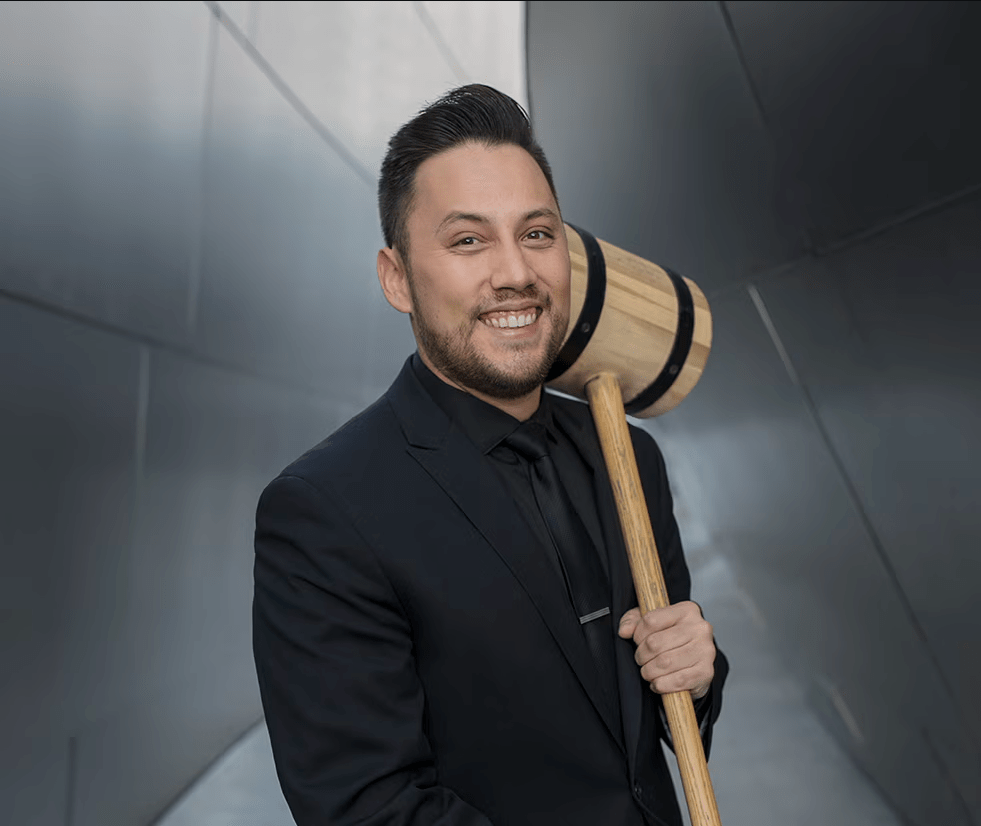
CKDH: So I heard a rumor when you got hired that you wanted your official picture to be with the Mahler 6 mallet. Yet for whatever reason, that wasn’t what was on the [website] bio for a while after you started. Then recently, when I checked again, you’ve got it now. So, bravo For actually putting it up.
I don’t know if you had to retake the shot. But is that story true?
MH: Yeah. (laughs) So when I first got to orchestra, I had that bouquet of mallets that everyone tends to have. “Oh, very, very nice.” But I’m like, “You know, we have all these things in this room. What are some cool things that I can bring in that I could take a picture with?” And so immediately thought the hammer.
Then the next time they gave me the choice. They were like. You can pick whatever headshot you want, and I was like, “You got it!”
—–
CKDH: Very nice! So let’s talk about the piece, Naru. So how did it start? whose idea was writing the concerto for you?
MH: So I guess you know, one big part of this was, of course, my roots, right? How I started off with Taiko, and that’s what’s spurred my passion for music in general, but mainly drums.
You know, and it kind of led me to take my one of my first timpani lessons with Joe. And now to flip it where we’re now here, and I’m now colleagues with one of my musical heroes. And now I get to play my roots on stage in front of my hometown orchestra in the front [of the stage].
So I think it’s just an all around amazing full circle moment for me, and I get to not only harken back to the roots of my career, of how I started, but also my heritage and I love nothing more than just to showcase the instrument, but also the heritage that got me to this point and started me on this path.
I think it’s absolutely beautiful. And I’m so grateful that he was okay doing that. And the other part of all this is that Japanese music, especially this style of Japanese music, is very percussion heavy. There’s that whole Kodō of just taiko on top of drums on top of cymbals on top of all of that, there’s just an endless amount of things that he could do. So I thought that was a very, very amazing category to write for.
CKDH: Did it start off where Gustavo, or someone in administration was like, “Hey, we’re going to have Joe write a concerto for you” . . . How, when, and where does that even start?
MH: About a year ago, I was told, from artistic [administration] that they want Joe to write me a concerto which I thought was perfect. It’s another percussionist that has amazing ideas that knows me very well. I think that’s a perfect fit.
CKDH: Obviously Joe’s renowned for this, composing in general and for percussion particularly. And you know him. How is it for you to premiering new music? Let’s start with preparation and mindset.
MH: One thing that I feel has also prepared me for this moment is the absolute amount of new compositions we do in the orchestra every single week. I think I remember our Centennial.
CKDH: Yeah, that was crazy.
MH: We did a new commission every single week. Now, of course, not every one of those was a percussion concerto, but a lot of them felt like it, you know? A lot of were very percussion, heavy, very featured. So I have been trained to learn a lot of these things very, very quickly and very efficiently. And I started doing that at New World [Symphony]. . . This isn’t something that’s foreign to me. And I absolutely am made for this.
[Part 2 of the interview continued in the next post]
RELATED POSTS:
- Comings and goings at the LA Phil and beyond (Summer 2016 edition): Lots of updates with principal chairs and more
- A chat with Raynor Carroll (Part 2 of 2): post-retirement plans and stories of his successor, soloing, conductors with whom he’s worked, and much more
- A chat with Raynor Carroll (part 1 of 2): the outgoing Principal Percussionist of the LA Phil talks about the joys and craziness of his job and the instruments he plays
—————
Photo credits:
- Matthew Howard: screenshot during Zoom meeting (May 28, 2025)
- Matthew Howard holding mallet: courtesy of the Los Angeles Philharmonic website
 All is Yar
Sent from my iPad
LikeLike
A couple of corrections:
LikeLike
Yikes. Fixed. Not sure how I messed up Houston and Toronto
LikeLike