
This is part 2 of my conversation from Tuesday, May 28, with Matthew Howard, the Los Angeles Philharmonic’s Principal Percussion (part 1 is HERE).
We continue our discussion about Naru, the percussion concerto Joseph Pereira wrote for him and the LA Phil receiving it’s premiere this week (Thursday, Saturday, and Sunday in Walt Disney Concert Hall, Friday night at Segerstrom Hall in Costa Mesa, presented by the Philharmonic Society of Orange County). We also talk about the challenges of doing a new piece in two different halls on back-to-back nights, his feelings about Gustavo Dudamel’s upcoming final season as LA Phil Music & Artistic Director, and more.
—–
CKDH: So was it your idea to have so much of the inspiration [for Naru] be Japanese drumming? Or was that Joe (Pereira) coming to you with that idea? How did that become so central to this particular piece?
MH: The first thing that happened after I found out that Joe was writing me the piece was that he came to me and said, “Okay, well, give me a starting point,” and that’s when I told him I think the best thing to do would be to feature my Japanese heritage. And so he went off and watched all these videos and started immersing himself in all these different styles and all these different groups.
Then along the way, he’d show me some audio clips of things. He’s thinking about some sounds, some certain drums that he’s planning on featuring, certain passages, and we would discuss a lot of them. He locked himself in a room for about 8 months and was dialing things in trying to figure out how to transition between all these things. Near the tail end is when I started to be a little bit more involved with the process, but I had to spend a lot of time just learning it, learning about it.
CKDH: Given that you had more familiarity with some of those instruments than he had, did you steer him in any direction, or give him something like, “Hey, it would be great if you did X,” or “You know, this part Y isn’t going to work like that.”
I think back to Jeffrey Reynolds, the retired bass trombone for the LA Phil. When someone wrote him a concerto [Larry Lipkis’s Harlequin], his request only was “No glissandi” because he was too tired of the whole stereotype of doing gliss on trombones.
Did you have anything like that for him?
MH: I didn’t want to put any restraints on him because his ear for sounds and knowledge of percussion is incredible. So I just said, “You do your thing (laughs). I gave you a good jumping off point. I’m more than happy to storyboard some stuff with you, but otherwise, have at it.” So no, I was not sending him a lot of stuff.
CKDH: There’s a lot of percussion [in Naru] besides the soloist. I was looking at the orchestration; there’s all the solo stuff you’re playing at the front of the stage, but the list of instruments that the section is playing is twice as long.
MH: Yeah, it is.
CKDH: Can you give me a preview of how much interaction you have?
MH: You’re right, it’s a lot [of percussion in the orchestra]. And a lot of the instrumentation that he chose for the percussion section is a Japanese inspired, but the other part is sonically inspired: some of the sonorities of the gongs or non-traditional music, some of the almglocken, [which are like] cowbells. These types of sounds fit into my sound a little bit more and the sounds that the orchestras are producing. We wouldn’t use those in Japanese music, but sonically they fit. They help enhance the sound of what Joe is looking for in my solo part as well.
You have these really extended sections where I play a shime-daiko, which is basically the snare drum of taiko drumming. It’s a small, really high-pitched drum. Normally groups play them, there’s 4 or 5 of them, and they stagger their entrances and move up and down. It’s a cool harmonic experience because you have all these different timbres moving up and down, and it changes in your ear as they start swelling. . . .
There is an extended point where I start really, really soft on the edge of a shime-daiko and move up in volume, and everyone starts joining, and everyone comes up and down in different at different times. There’s a lot of section play when it comes with that.
But there are also other times where I’m playing a vibraphone with something called a mallet station, which is an electronic mallet instrument that’s tuned to about a quarter tone below or an 8th tone below my instrument. So it’s a little bit clashy. But whenever I hit that in one of these slow sections it triggers the marimba player to do these trills or something else in the group. It’s very interactive when it comes with stuff like that as well.
CKDH: You said you got it a few months back. It’s not like you have a shime-daiko or a mallet station sitting around the house. Or maybe you do, but I doubt you have all the solo instruments or enough room to set them up and practice. Have you rented out some soundstage somewhere to practice? It’s not like a violinist who just sheds this in their living room.
MH: Well, luckily we have a very large percussion room at Walt Disney Concert Hall, with which we are very blessed.
There was the vibraphone and mallet station and going back and forth between those 2 levels. Everything else is standard: some toms and cymbal stuff, this other station with wooden discs which are fine, basically like another drum part, a taiko part which I can make do playing on something else, because we don’t own taiko, so I can play on a bass drum or something like that.
MH: But one thing I needed the most time on is this instrument called a waterphone. Most of my cadenzas are going to be on it.
It’s basically a big metal basin with rods coming out of it, and there’s an inner tube that I hold on to. Normally you fill it with water, and you can bow these rods on it and move it around and change the pitch with the water.
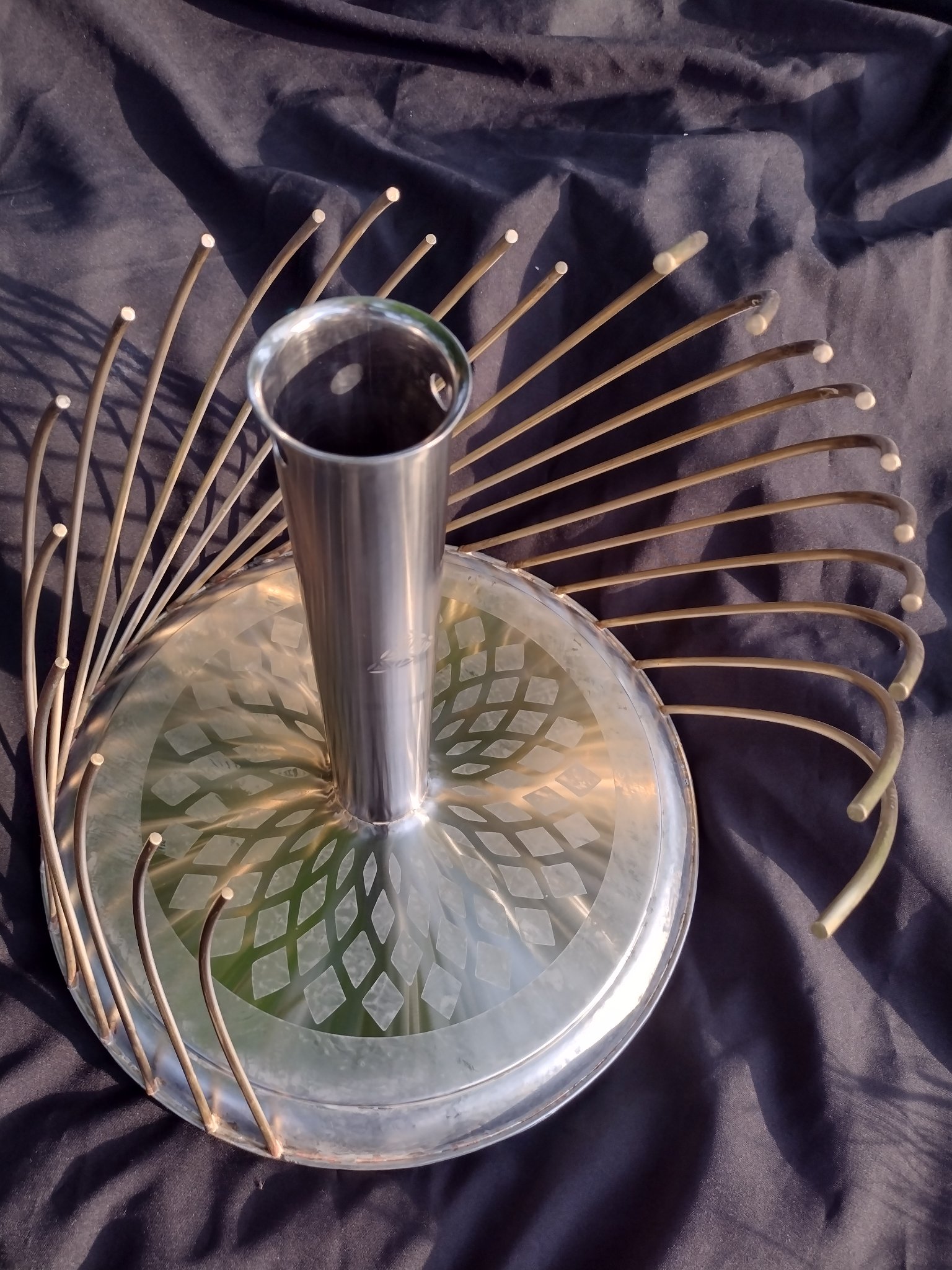 But this certain instrument that Joe got, which is a new fancy instrument called a Sailophone. Instead of these rods going straight up and down, they curve around so they actually can get much lower.
It is a very heavy instrument. . . . I’m going to have to sit there and explore the instrument, and people are going to watch me explore this instrument, because it’s going to be resting on top of a bass drum. I’m going to be finding certain spots that resonate best on the bass drum, lifting it, bowing it on certain pegs, and creating something in the moment.
I really had to do most of my work on that instrument. Just to really make sure that I knew exactly how to control all of the things I wanted.
CKDH: Were all the cadenzas written out or not? How much improv are you able to do?
MH: Well, he gave me some brief ideas, and we still were talking about it even today. There’s a general plan with it, but within that I have a lot of liberty. He wrote out some stuff and gave me some good groundwork, but I can basically do whatever I want and tell my own story with it.
CKDH: As you said earlier, you’re the one normally having to lay out the stage. Did you get a break from that with this? And did you even worry about the front set up? When you’ve got Joe P. writing a piece for you, he kind of knows his way around percussion. So did he have the vision for how the instruments at the front of the stage were going to get laid out?
MH: (Laughs). So just to start with, I had to do all of the breakdown of all the stuff in the back. Still, even though I’m at the front. It’s totally fine (laughs).
MH: But as to the soloist setup, I actually made it. He had a diagram of how we wanted it set. He had it all so that the instruments were all facing towards the conductor. I’m surrounding the conductor in instruments, so I’m not all going to be lined up at the front of the stage. I’m going to be encapsulating the conductor. The vibraphone and the tom station are going to be angled at him so I can see him, but the others, I wanted it [set up] so I’m facing out, and I’m able to perform towards the audience a little bit more.
The taiko are going to be very performative and huge, so I didn’t want to just have that be for the orchestra or the conductor. I wanted the audience to be the ones to really get the impact of that. Same with like the wood disc and the centerpiece of the entire thing is going to be the water phone on the bass drum. It’s very visually striking, and it’s again going to be where I have the majority of the cadenzas.
CKDH: Hopefully,someone gets a good picture of that.
MH: Yeah, I’m very sure whoever’s sitting in the front row is gonna get more than a picture. They’re gonna get a lot of the instruments.
CKDH: Is it like Sea World where there’s a splash warning for the people in the first 4 rows?
MH: You’re gonna have to come to the shows and find out! (laughs)
CKDH: Speaking of being in the hall: you obviously know Disney Hall really well; that’s your office. But you’re also taking this show on the road. You’ve played Segerstrom Concert Hall a few times, but clearly not you’re not as familiar with it and you’ve never played a solo there. It has very good acoustics, but very different acoustics from Walt Disney Concert Hall.
How do you deal with the fact that you’re going do the world premiere in WDCH, and then immediately, you’re basically going, “All right, let’s pack this all up and go into a brand new stage.” What’s the mindset kind of how you are approaching that variable?
MH: Well, I’m an easy-going guy. I will roll with the punches. That is okay. As far as Segerstrom is concerned, I know for certain that that place is significantly more live than Walt Disney Concert Hall. Sound tends to carry a lot quicker over there than in our hall. So my goal is to not make the roof crumble down (laughs). I still want to make sure there’s stone plaster in the in the ceilings. By the time I leave.
Really, I wanna make sure that I’m not the only one heard. That the orchestra is also heard over me. As far as my comfort, I’m making sure to go down there plenty early on Friday. We have a tech rehearsal because there’s an electronic aspect to this. We’re making sure that everything is well thought of and that I can get some time on that stage by myself, just to make sure I feel comfortable.
CKDH: From where I usually sit in the audience, they usually put us in the back end of the orchestra section, and there’s a bit of a rake. So we get great sound and a good view, too. So I’m looking forward to that and being able to compare it to Disney Hall on Sunday.
But Segerstrom definitely has more of a wash of sound, more of a blended sound than the pinpoint clarity in Disney Hall. It’ll be a fun change.
MH: You gotta let me know what you think.
CKDH: I’ll definitely give you the heads up.
MH: Please do.

CKDH: How about the conductor, Gustavo Gimeno? It’s one thing to be the soloist for a world premiere with Gustavo Dudamel (LA Phil Music & Artistic Director) or someone that you work with every single year. Whereas Gustavo Gimeno: not so much. That’s not a diss on him at all, he’s obviously a very capable conductor.
But what’s it like doing a world premiere with someone you work with regularly?
MH: First off, I think besides Gustavo Dudamel or even Esa-Pekka [Salonen], the next person in line that I feel would be perfect for percussion concerto would be Gustavo Gimeno because he was formerly a principal percussionist of the Royal Concertgebouw. For someone to be not only an elite conductor, but also have this unbelievable background in percussion: it’s perfect.
He can read these rhythm. He knows the intricacies and knows what to listen for discussing sounds, all of that stuff, he is well versed in. I was extremely thrilled when I heard that he was going to be the one conducting this.
CKDH: Awesome. How much communication have you had on this with him, if any?
MH: Joe and I just had our run through today with him. We ran through the whole thing. Talked about transitions, queues, things like that, and some balance things. We’re gonna get more into it tomorrow when we actually do it with the full orchestra.
CKDH: You ever think about getting into conducting?
MH: Me? No, no, no! I mean I think I could keep time — very well, that’s for sure! (laughs) All the other stuff maybe not so much.
CKDH: Speaking of conductors and Gustavo Dudamel: you’ve been in the orchestra for a while now, and you’re seeing some transition.
You got hired by Gustavo Dudamel, and we’re on the eve of his final season. What it’s been like with him as music director?
MH: Magical. I know I’m biased because he hired me, but his programming, his style of conducting, the amount that he lets us all play as musicians, the music directions, talking to him about sounds or anything music related. He’s so open to discussing all these things with you, and on top of that he’s just an amazing human. He’s very down to Earth, and he’s very normal.
I feel very humbling and inspiring to see someone like that who’s at the tippity top. He gets to rub shoulders with all these absolute elite celebrities. Yet here he is, conducting whatever piece that he is doing, and just willing to talk about triangle options (laughs) or something like that, and he loves doing it. He loves talking about all these things.
CKDH: Does he actually get into triangle options and other things like that? Does he ever say, “You really should use that solid rubber core mallet the next time instead of the cork one” or anything similar?
MH: No (laughs). I might give him a couple of options. He doesn’t know the specifics like that.
Other than that, it’s bittersweet. He’s still gonna be around, of course. But when he mentioned to us that he was leaving, I had a nice talk with him, and it was kind of emotional. I was like, “Dude. I just want to let you know that you changed my life, and I cherish every moment that you’re on stage with us. Thank you.” He’s an absolute, incredible person.
CKDH: Speaking of open positions, will you be able to fill [retired LA Phil percussionist] Perry Dreiman’s open position anytime soon?
MH: Yeah, I would absolutely love to fill that. We are one person down and on top of another person, our Resident Fellow. So [the percussion section] is currently just me, David Riccobono, and Jim. But, there are a long list of jobs [in the orchestra] that need to get filled first.
We were able to hire a Fellow: Jeremy Davis from Rice, who actually went to USC for undergrad. That’ll be fun to have him join next season.
CKDH: Speaking of schools, are you on anybody’s faculty already or are you gonna join anybody’s faculty?
MH: Oh, I’m not. No, I help out at USC every now and then, but no.
CKDH: You’ve been awesome. I really appreciate the time. I can’t wait to see Naru. It’s obviously rare to get a new percussion concerto. Looking forward to seeing if you’ve got any secrets planned for the cadenza, like maybe taking your shirt off and doing hand percussion on your body.
MH: How do you know that I’m not? It’s the secret surprise. And the basin.
CKDH: Oh so you’re going to pour the water over your head—that’s gonna be the grand finale?
MH: (laughs) It is! It’s how the whole piece ends.
CKDH: You can also use them as cadenza ideas. Take full credit for it. I don’t mind really.
MH: Okay. I’ll take half credit (laughs)
CKDH: I look forward to it! Thanks again.
MH: You too!
RELATED POSTS
- A chat with Matt Howard (part 1 of 2): LA Phil Principal Percussion talks about how he got started in music, his awesome job, and starts to talk about the origin of “Naru”
- Comings and goings at the LA Phil and beyond (Summer 2016 edition): Lots of updates with principal chairs and more
- A chat with Raynor Carroll (Part 2 of 2): post-retirement plans and stories of his successor, soloing, conductors with whom he’s worked, and much more
- A chat with Raynor Carroll (part 1 of 2): the outgoing Principal Percussionist of the LA Phil talks about the joys and craziness of his job and the instruments he plays
—————
Photo credits:
- Matthew Howard: courtesy of Matt Howard Percussion Academy
- Hyperstellar Sailophone: courtesy of https://waterphone.pl/portfolio/hyperstellarsailophone/
- Gustavo Gimeno: photo by Marco Borggreve, courtesy of the artist’s website
 All is Yar