A magnificent “Marriage of Figaro:” LA Phil’s modern staging of Mozart classic is a huge success on all fronts
May 21, 2013 Leave a comment
This past Friday night, the Los Angeles Philharmonic unveiled the latest foray into its three-year “Mozart/DaPonte Trilogy” project, the first ever performance (staged or otherwise) of The Marriage of Figaro in the orchestra’s history. It was glorious in every respect: visually striking, dramatically compelling, and musically excellent.
Before a single note was played, one marveled at the alterations to the Walt Disney Concert Hall stage. This year’s production design was turned over to Parisians Jean Nouvel and Azzedine Alaïa, and the two Frenchman came up with drastically different solutions than their predecessors to the challenges offered by doing opera in this iconic but non-traditional space:
-
For last year’s Don Giovanni, SoCal-based starchitect Frank Gehry invented a jagged white landscape, creating an other-worldly environment which clearly differentiated the stage from the sweeping curves of the warm, wood-panelled room he painstakingly designed for regular concerts. The sisters Kate and Laura Mulleavy, heads of the LA fashion house Rodarte, responded by creating richly detailed costumes that look like they came out of a sci-fi/fantasy movie.
- In contrast, Mr. Nouvel consciously embraces and celebrates WDCH’s interior design language, most dramatically in the steep “hill” on the back of the stage where choir benches normally would be:
- Nearly smooth convex curves at the extreme wings warp into wavy tiers that, at their center, flank a grand staircase leading to the base of Disney Hall’s famous organ. Here, the organ bench is supplanted by a massive sofa of a throne for Count Almaviva.
- The wavy tiers themselves have practical applications, serving as places for the cast to act, pose, or wait (whatever the action requires).
- In addition, the extreme sides have cutouts which serve as entrance/exits to and from the stage; this was necessitated by the regular doors offstage being blocked by the placement of the LA Phil in a shallow oval pit at the front of the stage — a much more natural location vs. the orchestra being behind the stage as it was for Don Giovanni.
- Enveloping the orchestra pit were two arms that reached out to the front of the stage, creating a space for the cast to work, not unlike the oval runway in front of the stage at a U2 concert where Bono would prance about.
- Frankly, I can’t imagine a more perfect solution to staging opera in Disney Hall. This set-up should be repurposed early and often, or at a minimum, it should serve as the template — the “approved solution,” if you will — for future such productions.
- In a similar vein, Mr. Alaïa places the cast in contemporary outfits that would look natural in the couture salons of Paris or the red carpet at the Academy Awards. He took advantage of having a cast of many young and athletic singers by clothing them in some figure-flattering (read: snug-fitting) costumes. If his designs for the women were more impressive than the pleasant but rather standard-looking outfits he gave to the men (the notable exception being Figaro’s magnificent zipper jacket featuring a gold geometric pattern on a black background), one can forgive him.
Director Christopher Alden played along, crafting more natural movement and blocking for the singers than he demanded in the stylized, Robert Wilson-like slow-motion of last year’s Don Giovanni. Moreover, he kept the action much less heavy-handed than he did last year, neither forcing intensity nor inventing unnecessary conflict where none existed. His integration of some of the characters not normally involved in particular scenes was more clever than distracting, and the comedy he presented was more subtle and sarcastic than slapstick (some blatantly fun tricks notwithstanding). He was aided greatly by Aaron Black’s lighting, which helped to focus attention where needed on a mostly stark stage, and which also added atmosphere with scenic projections above and behind the stage that changed with each act.
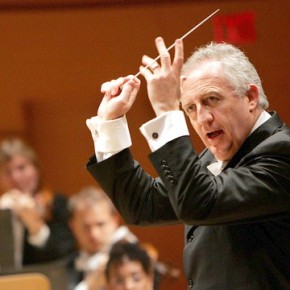
Similarly, Gustavo Dudamel’s approach was more agile and fluid, with translucent textures that allowed inner voices of the LA Phil to shine through. The whole orchestra sounded exquisite, and in particular, woodwind principals Whitney Crockett (bassoon)), Ariana Ghez (oboe), Michele Zukovsky (clarinet), and Cathy Karoly (flute) were outstanding. Just as importantly, Mr. Dudamel’s more traditional placement in front the singers allowed him to more sensitively respond to and interact directly with the singers on stage. This allowed for tighter integration and more spontaneity, serving both music and staging well.
Perhaps the most surprising aspect of the staging was the number of times the cast sang with their backs to the front of the stage. This is almost always a no-no for both dramatic and musical reasons; however, with the crystalline acoustics of Disney Hall combined with what is certainly a sonically resonant stage created by Mr. Nouvel, they not only got away with it, they pulled it off well, and it allowed for some creative blocking.
The combined effect was the creation of a present-day hyper-reality for the action to take place, like we were all peeking in on an abstract reality TV show set in the court of Count and Countess Almaviva — all that’s missing is a TMZ camera or two.
Of course, a handsome staging in and of itself does not an excellent Marriage of Figaro make. Thankfully, we were blessed with an excellent cast that, in addition to looking great, sang beautifully and acted well too.


: a backstage pic of Dorothea Röschmann (Countess), plus a photo of Simone Osborne (Barbarina) by Mr. Molina.


The Los Angeles Chamber Orchestra often plays larger symphonic works — and does so quite well — but one of the joys and privileges of having a standing chamber group like them is the chance to hear pieces written for small to medium-sized ensembles that a full-sized orchestra would not take on. Their most recent concerts were laden with concertante works by Mozart, Stravinsky, Bach, and Handel — the kind of concert for which they are very well-suited and play at an extremely high level.


Recent Comments