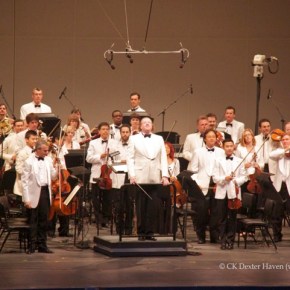
Le Hollywood Bowl avec un accent français: Denève, Thibaudet, and the LA Phil revel in a Franco-American program

When it comes to standard musical fare at the Hollywood Bowl, it’s tough to come up with two composers more iconic than George Gershwin and Leonard Bernstein.  Besides having their music performed pretty much every summer in the Cahuenga Pass, the two Americans have other close ties to the Bowl:

  • The 1937  memorial concert commemorating Gershwin’s too short life was famously broadcast from the Hollywood Bowl, and featured the Los Angeles Philharmonic with a whole host of performers, likely and unlikely, who came to honor the man who first merged jazz and classical music.  (BTW:  the recording of the concert is a must-have, and includes all sorts of good stuff, including a quirky transcription of the Piano Prelude No. 2 conducted by Otto Klemperer, the LA Phil’s music director at the time.)
  • Bernstein spent a few summers conducting at the Bowl, most notably as one of the founders and artistic directors of the now-defunct Los Angeles Philharmonic Institute.

So seeing their music on last Thursday’s program, along with works from Gershwin’s French contemporary, Maurice Ravel, seemed de rigueur — at least at first.  Leave it to conductor Stéphane Denève to put a slightly different spin on the night:  the theme would be Americans influenced by the French, and French influenced by Americans.  Just for good measure, he brought along French pianist and Los Angeles resident, Jean-Yves Thibaudet.

The Marquis de Lafayette, Josephine Baker,  Frédéric Bartholdi, and Jerry Lewis would have undoubtably approved of the sentiment.  I certainly approved of the outcome.

Mr. Denève proved to be charming, both in his remarks from the stage and in his musical interpretations.  The LA Phil sounded quite nice, with many notable solos being contributed by players within their ranks.  Mr. Thibaudet knocked the stuffing out of a concerto that was right in his wheel house.  Even the Bowl’s temperamental A/V system mostly behaved.  There was much to enjoy, and very little to fuss about.

Read more of this post

There’s still time left to celebrate National Scotch Day

Happy Friday.  More importantly, Happy National Scotch Day.

No, seriously, it’s National Scotch Day — for real.

If you didn’t know that, you’ve admittedly lost a good chunk of your opportunity to celebrate on the actual day of honour (see what I did there by putting a “u” in, just like the Scots do?).  Good thing I told you while there were still some hours in the day to raise a dram and do the day up right.

Not a fan of scotch whisky, but still want to partake? Are you scared by some past experience you may have had or by what another person may have told you?  Have no fear, and allow me to recommend something for you, the rookie:

Read more of this post

Going out with style: Tokyo String Quartet bids a fond farewell to Chicago

This past Tuesday, the Tokyo String Quartet played what first violin Martin Beaver said would almost certainly be their last concert at the Ravinia Festival.  In all likelihood, it will also be their final appearance anywhere in the Chicago area.  With Kazuhide Isomura (founding viola)  and Kikuei Ikeda (longtime second violin) deciding to retire, the whole ensemble is calling it quits after the 2012/2013 season.  It was “an evening full of meaning for us,” according to Mr. Beaver.

That I was there to experience it was a confluence of lucky events.  A week before, I didn’t know I’d be in Chicago.  The day before, I wasn’t sure if I’d be attending.  That morning, a massive thunderstorm rolled through the region, complete with hail and some not-messin’-around wind causing widespread damage and some power outages.

Around lunch time, the rain stopped, but I got a weather alert on my phone warning of “Severe Heat” with temperatures between 100 and 104 degrees with a heat index of up to 110 degrees once you factored in the humidity;  however, this turned out to be a warning for Wednesday, not the night of the concert  By the time I arrived at Ravinia around 6:30pm, the skies had cleared and the temperature was a very SoCal-like mid-70′s with moderate humidity.  Nothing would get in the way of the chance to see this concert.

Lucky me — and very lucky, too, for the near-capacity crowd inside Martin Theatre and the many others picnicking outside.  The Tokyo Quartet treated everyone to an evening that was enjoyable on so many levels.

Read more of this post

This week’s concerts (cross country edition)

This week at the Hollywood Bowl, conductor Stéphane Denève returns to Southern California to lead the Los Angeles Philharmonic in two different programs.

  • Tuesday’s concert features two works not often heard at the Bowl (or anywhere else for that matter):  Stokowski’s “Symphonic Synthesis” of Mussorgsky’s music from Boris Godunov and the lone violin concerto of Julius Conus.  Martin Chalifour, the LA Phil’s Principal Concertmaster, will be the soloist; he has made it a habit to do rarely performed concertos (much like one of his predecessors, David Frisina), and this is another fine example of that.  Rachmaninoff’s Symphonic Dances ends the evening on a more familiar note.
  • Thursday’s concert is a compelling program loaded with much more typical Bowl fare, including  Bernstein’s Candide Overture and On the Town, Gershwin’s An American in Paris, and two works by Maurice Ravel:  the Piano Concerto in G with Jean-Yves Thibaudet as soloist and the Daphnis and Chloe Suite No. 2.

Mr. Denève had been a regular visitor to Los Angeles for a few years, but didn’t appear this last season at Walt Disney Concert Hall, nor is he scheduled to appear this coming 2012/2013 season.  If you want to catch this increasingly prominent conductor, you’ll have to do it this week.

While both concerts look quite interesting, I’ll only be at Thursday night’s performance — that’s because I currently happen to be in Chicago where, asides from trying to dodge lightning storms and other random stuff, I’m planning on being at Ravinia tonight to catch the Tokyo String Quartet’s final Chicago appearance before retiring.  The program includes:  “The Rider” quartet of Haydn; the original string quartet version of  Webern’s Five Movements, Op. 5, along with his Langsamer Satz (“Slow Movement”); and finally, the third “Razumovsky” Quartet of Beethoven.  Let’s hope the weather cooperates.

—————

Photo credits:

  • Ravinia, Tyler Gate:   courtesy of the Ravinia Festival
  • Hollywood Bowl:  courtesy of Los Angeles Philharmonic Association

Twitter: where Esa-Pekka Salonen and The Rite Offspring (?!) coexist

For the longest time when it came to Twitter, I fought the power.  I thought it served best as a source of comedic fodder for late night talk shows and their friends (e.g. how could anything ever top this brilliance?  I gained a newfound respect for Josh Groban after seeing it).

I finally jumped into the fray early this year, and since then, well . . . it has exceeded my very low original expectations.  It has proven to be a good source of timely information, not to mention an occasional source of unexpected amusement.  That said, you often have to wade through a lot of chaff to get to the Twitter grain, and because of that, I sometimes take a few days off at time from reading my Twitter feed.  Usually, this is no big loss.  Sometimes, though, you can miss out on something cool or fun, especially if you don’t scroll back in time.

Today, for example, Esa-Pekka Salonen tweeted links to musical clips of two of his compositions — the Violin Concerto with Leila Josefowicz and Nyx — and had I not actually logged in today, I probably wouldn’t have learned about that.  (I also learned that the upcoming Deutsche Grammophon release of these two works will feature the Finnish Radio Orchestra instead of the Los Angeles Philharmonic — a topic for a different post on another day).

I took a multi-day break from Twitter earlier this week, and almost missed out on some silly musical fun, care of The Royal Conservatory of Canada.

Read more of this post

DSO streaming Mahler 5th, with Manny Ax playing the Mozart 22nd

Happy Friday.  In case you don’t make it out to any concerts this weekend, the concert can come to you:

Between now and Monday at 12noon Eastern Time, the Detroit Symphony is streaming their recent performance of Music Director Leonard Slatkin conducting  the Mahler Fifth Symphony and the Mozart Piano Concerto No. 22 with Emanuel Ax serving as soloist.  Click HERE, enter a little bit of registration information, and voila!  You’re in.

Read more of this post

Summer seasons, Week Two (times two)

I’m not able to make any concerts this week due to various conflicts, but that shouldn’t keep any of you from going, nor should it keep me from talking about them. . . .

Hollywood Bowl, Week 2
The Los Angeles Philharmonic second week of summer classical concerts were programmed similarly to the way Week 1 began:  program new music in the first half and an unabashed warhorse after intermission.  This time around, the contemporary work was the West Coast premiere of Edgar Meyer’s Double Concerto for violin and bass, with Joshua Bell and the composer as soloists; the warhorse was Mendelssohn’s ubiquitous Violin Concerto, featuring Mr. Bell  once again.   Two overtures by Weber got thrown in for good measure.  The conductor was Ludovic Morlot, the Seattle Symphony’s new music director and the Boston Symphony’s pinch hitter during their recent West Coast visit.

Brian Lauritzen got some time for one-on-one interviews with both Mr. Bell and Mr. Meyer.  Mr.  Mark Swed attended last night’s concert (he liked it).   The program repeats Thursday night with the same conductor and soloists.

Southwest Chamber Music’s  Summer Festival at the Huntington Library, Week 2
This summer, Southwest honors the centenary of Julia Child with programs dominated by French music, and the opportunity to either picnic on the grounds or eat three-course meals at the Huntington’s Tea Room.  I was disappointed to not be able to attend the first pair of concerts this past weekend featuring works by Ravel, Jolivet, and Debussy (including his famed String Quartet) as they were high on my wish list.  Apparently, it was high on a lot of people’s list:  last Saturday’s concert had Southwest’s best audience ever, including a sold out Loggia.

This coming Saturday and Sunday, the program features Suite bergamasque by Debussy, the piano quintet version of Milhaud’s La création du monde,  Ravel’s Chansons madécasses, and the Quintet for Piano and Strings by Franck.  Tickets are still available for both nights.  A video preview can be found HERE.

—————

Photo credit:  Loggia Southwest, Huntington Library (Tim Street-Porter)

Of wine and white jackets, composing women and killer whales: the start of the 2012 Hollywood Bowl season

Composers Anna Clyne, Anne LeBaron, and Cindy McTee

It was time for musicians to break out their summer whites and for the audiences to try to not roll empty bottles of wine down concrete steps.  That’s right:  I’m talking about summer at the Hollywood Bowl.

After a few concerts of playing back-up band to Barry Manilow, the Los Angeles Philharmonic opened the classical music portion of the 2012 summer season last Tuesday in an unlikely fashion:  playing three works written by living composers — living female composers, no less. If you throw in two concerts of playing the world premiere of George Fenton’s Frozen Planet in Concert, this was a non-trivial amount of new music that the orchestra had to digest.

Granted, it wasn’t as a big a challenge as, say, playing Don Giovanni and The Gospel According to the Other Mary in short succession, but it’s not like the musicians could just put it on autopilot even if they wanted to. Considering the usual penchant for warhorses at the Cahuenga Pass combined with the limited rehearsal time in the summer, this was rather noteworthy.  And if you added in the single performance of Beethoven’s Ninth Symphony, a work that can hardly be thrown together nonchalantly, it all made for a relatively ambitious and auspicious start to the Bowl season.

When everything was said and done, it all worked quite nicely, even in an environment that can be filled with  attention-deficit concertgoers, many of whom were generally unfamiliar with any contemporary classical music and only there for the Beethoven. Credit conductor Leonard Slatkin for putting together a program that gelled and for inspiring compelling performances from the orchestra.  He may not always be the easiest conductor to follow (he tends to conduct waaaay ahead of the beat), but there is clearly enough chemistry between him and the LA Phil that they can give him what he wants with equal parts precision and finesse.

It was a satisfying evening, easy to enjoy and full of musical rewards.

Read more of this post

LA Phil is gonna need a new Principal Flute — again

In May 2010, a few months after Mathieu Dufour decided to return to his old chair in Chicago, the Los Angeles Philharmonic held auditions for a new Principal Flute to replace him.  They ended up offering the position to David Buck, then principal with the Oregon Symphony, without requiring any kind of trial period.

Fast forward to the present, and it appears that after two years of playing with the orchestra, Mr. Buck was not awarded tenure in the position.  So in the near future, the LA Phil will need to find a Principal Flute once again.  This is on top of the Second Flute audition that the orchestra is holding this coming August, the second attempt to permanently fill the position that has been handled by substitute players since Cathy Karoly was promoted to Associate Principal in 2009.

In the meantime, Mr. Buck is getting ready to make his next move — earlier this week, he won the Principal Flute audition with the Detroit Symphony.  It’s good to see that he landed on his feet.  No confirmation yet on when he will officially depart Southern California for Michigan.

—————

Photo:  Los Angeles Philharmonic Association

Musical and visual delights for your Independence Day

E.E. Begley, composer

Happy Birthday, United States of America!

The typical celebratory music for the occasion would be a march by John Philip Sousa.  Certainly, Sousa marches such as The Stars and Stripes Forever, The Washington Post, and Semper Fidelis, are the very definition of patriotic marches for most Americans.

Of course, there are other American marches by other American march composers — I’m guessing people hear them and just assume that they are by Sousa.  Among these non-Sousa marches, National Emblem by Edwin Eugene Begley is probably the most famous, with three distinct tunes that most anyone would recognize.  Its first section features an interpolation of The Star-Spangled Banner, the second theme is a recognizable circus melody (often sung with some, ahem, “colorful” lyrics), and the trio is used by many, including the Indiana University marching band whenever their football team makes a first down.  Incidentally, E.E. Begley’s brother — Ezra Begley — was a former Principal Trumpet of the Boston Symphony.

You can legally download MP3s of National Emblem as done by the USAF Heritage of America Band (HERE) and by “The President’s Own” United States Marine Band (HERE).  Personally, I like the  overall performance and sound quality of the Air Force band’s recording a little better, but the Marine Band’s recording is a bit more transparent.  Heck, they’re free — download them both, and decide for yourself which is better.

If you don’t feel like going through all of that, just play the YouTube video below of the same USAF Heritage of America Band performance.

Read more of this post

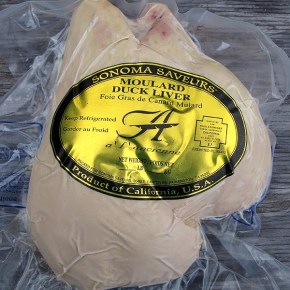
Farewell for now, foie gras — and many thanks to Michael Cimarusti, José Andrés, et al, over the years

I don’t remember the first time I had foie gras, but I definitely know when and where I fell in love with it:  it was at Water Grill in Downtown LA, right before the turn of the New Millenium.  Michael Cimarusti had taken over the kitchen from Allyson Thurber a year or two before.

On this particular night’s five-course tasting menu, the chef offered up an appetizer of “foie gras au torchon” that was poached or somehow otherwise infused with cognac.

It was insanely good.  ”Decadent,” was the actual word that immediately came to mind after I put that first bite of foie gras yumminess smeared onto a brioche toast point into my mouth.  I was hooked, and fortunately for me, the portion size was extremely generous — almost too much of a good thing.  Almost.

So it is poetic and more than a tad melancholy that the last time I’m likely to have foie gras in California (for the foreseeable future, at least) was at the hand of Michael Cimarusti, now chef and owner of Providence on Melrose Avenue. A few days ago, Mrs. CKDH and I sat down for a 15-course chef’s tasting menu*, where his joint seafood and foie gras brilliance was manifest in two of the dishes:
Read more of this post

%d bloggers like this: