One of the Southern California orchestras looking for a new leader found their person.
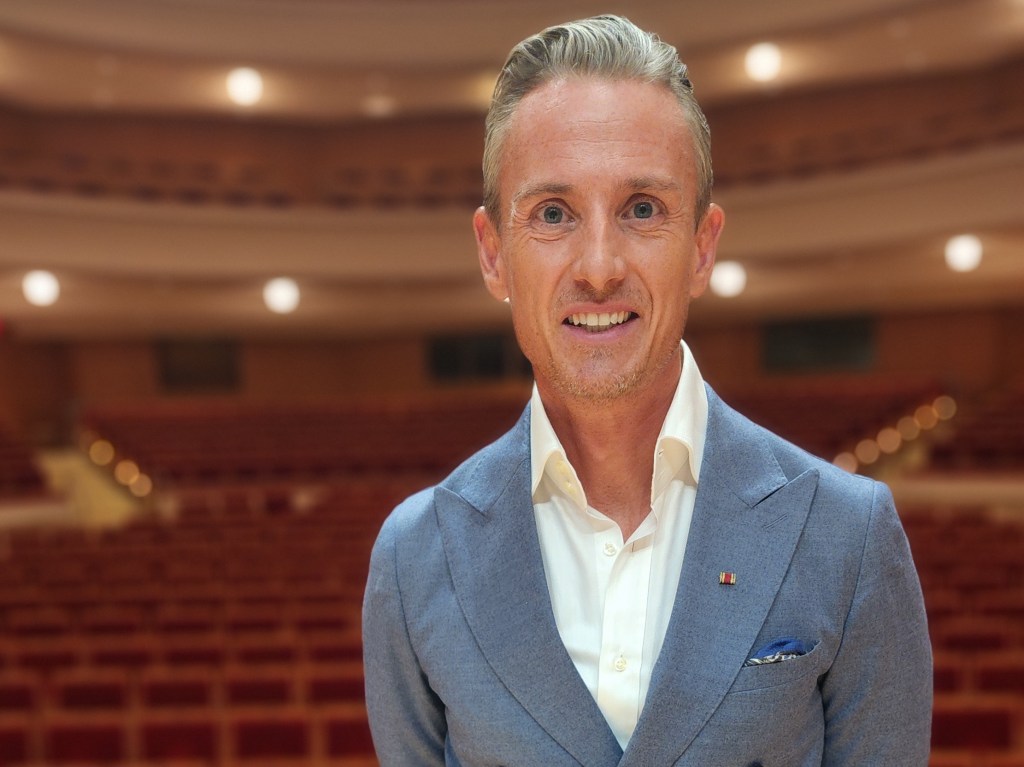
This past Wednesday at Segerstrom Concert Hall, the Pacific Symphony officially introduced Alexander Shelley as their next Artistic & Music Director. He will serve as Music Director Designate for the 2025-26 season and officially take the post in Fall of 2026, becoming only the third Music Director in the Orange County orchestra’s history. Carl St.Clair, Music Director since 1990, had previously announced he’d retire at the end of the 2024-25 season; Keith Clarke, one of the orchestra’s founders, held the post from 1979 to 1989.
Mr. Shelley’s initial contract runs for five years. He will make multiple appearances in the interim, the first of which was moved up to May 2025, featuring Beethoven’s 5th Symphony and 5th Piano Concerto, the “Emperor” (with George Li as soloist), along with works by Tan Dun and Iman Habibi.
The 45-year old British conductor is the son of noted classical musicians Howard Shelley and Hilary Macnamara, and he made a point to mention that music was ever-present in his youth. He eventually concentrated his instrumental studies on the cello, and was a member of the 2003 World Orchestra for Peace conducted by Valery Gergiev.
He initially gained attention for his conducting when he won first prize in the 2005 Leeds Conducting Competition. Since then, his posts have included the following, just to name a few:
- Music Director, National Arts Center Orchestra (NACO) (Ottawa): he replaced Pinchas Zukerman in 2015, and his current contract runs through 2026.
- Principal Associate Conductor, Royal Philharmonic Orchestra (London): 2015 – present.
- Artistic and Music Director of Artis—Naples and the Naples Philharmonic (Florida): his first US-based position, Mr. Shelley started the role a few months ago, taking over for Andrey Boreyko whose tenure ended in 2022; his current contract runs through the end of the 2027-28 season.
- Chief Conductor, Nuremberg Symphony Orchestra (Germany): he was the youngest-ever chief in the orchestra’s history when he took over in 2011, and he served until 2017.
He has been a guest conductor of orchestras throughout North and South America, Europe, Asia, and Australia, and he has led opera performances in Denmark, Canada, France, and Austria. He conducted the Stockholm Philharmonic for violinist Daniel Hope’s Deutsche Grammophon recording, “Escape to Paradise: The Hollywood Album.” He has also recorded with NACO on Analekta and the Nuremberg Symphony on Colosseum Records and Berlin Classics.
Mr. Shelley was one of eight men and women the Pacific Symphony had as guest conductors who were ostensibly Music Director candidates. Timothy Mangan reviewed all of them,including Mr. Shelley’s Dec 2023 try-out concerts. While he had good things to say about the works by Gubaidulina and Chopin on the program, he noted that the Dvorak “New World” Symphony gave the best measure of the eventual winner:
“He conducted the work without score, and fully engaged with the musicians. The interpretation was a pretty standard one but so full of rich detail that it sounded fresh and new. Shelley paid a lot of attention to dynamics, which were continually varied and carefully balanced. He also didn’t miss a beat in the transitions. A listener doesn’t necessarily lay in wait for the delight of transitions, but when they go this well it’s like sitting in the passenger seat of a well driven sports car.”
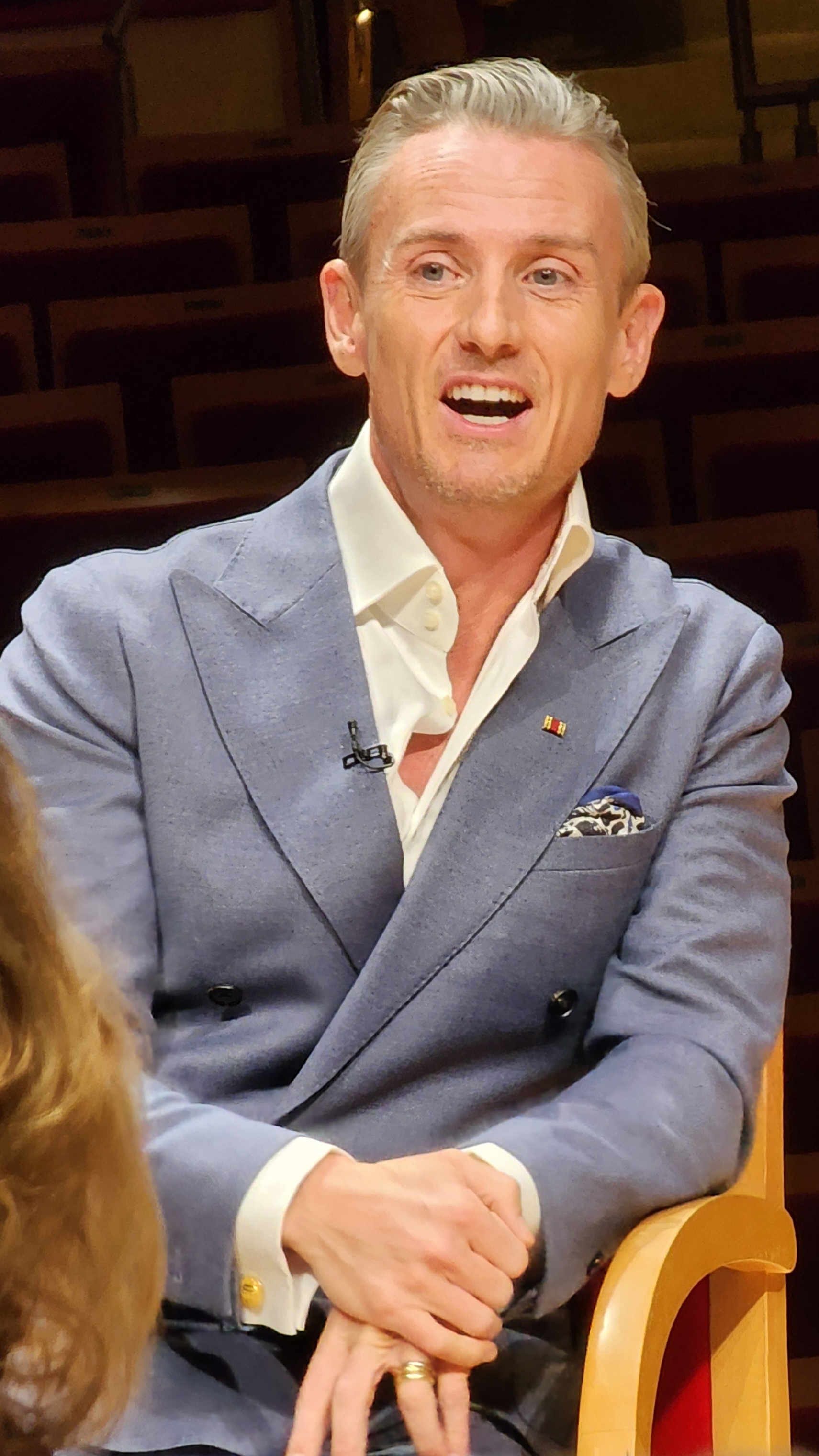
Mr. Mangan’s review also noted the conductor’s appearance and communication skills. Last Wednesday, it was very clear why. From the moment Mr. Shelley walked out for the introductory event, he exuded stylish charisma and confidence, cutting a dashing profile underlined by his choice of a Neopolitan double-breasted suit worn with an open-collared white dress shirt. Yet it was his communication style that stood out most. During a 30-minute conversation on stage with Maria Hall-Brown of PBS SoCal, he was relaxed and affable: one moment, he articulately described how he tries to shape orchestra sound or connect with audiences in pre-concert lectures; the next, he was telling stories about how in his 20s he was a member of a German cover band that morphed Britney Spears hits into swing numbers.
When asked what his hopes and dreams would be for the orchestra in the next five years, he noted:
- Even deeper community engagement: “The foundations that exist now as an incoming Artistic and Music Director, you couldn’t ask for more. The connection to the community is there: it’s real, it’s deep. The commitment to education, to the next generation of musicians, but also music lovers is there. First of all, we need to redouble those efforts. We need to make sure that we become ever more integrated in the community.”
- Increasing the orchestra’s profile beyond Southern California: “I would like this orchestra to be celebrated across this the continent and internationally, and I think it is wonderfully poised artistically to take that next step even further. I think there are levers we can pull, I think that touring to key regions will be a very important part of it. I’d love to put together a strategy for recording.”
- Multi-disciplinary collaborations: “I’d [also] love to put together a strategy for collaborating with some of today’s most interesting artists, both composers but also beyond: looking to literature, looking to the visual arts, looking to dance. . . . It’s one of the reasons it was important to me that my title is also Artistic as well as Music Director.”
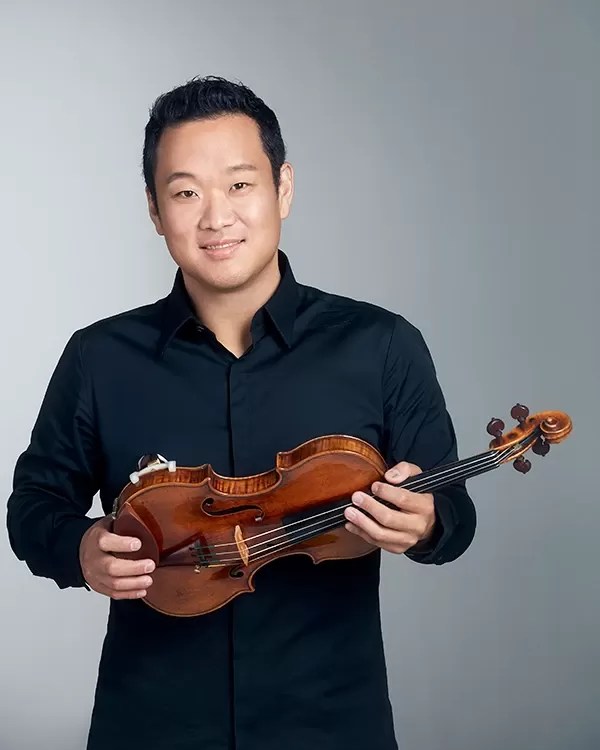 All of this likely contributed to his success in connecting with the orchestra’s musicians, patrons, and audiences. Feedback across the board was positive. The orchestra’s Concertmaster, Dennis Kim, noted separately to me that while all the guest conductors were capable, the chemistry with Mr. Shelley was palpable from the moment they began rehearsing through to those December 2023 performances. “There was just something there that is hard to describe, but it was clear to me and others.” He also noted that the process with which the organization conducted the search made the evaluation better. “As it happens, I’ve been involved in other searches at my previous orchestras, and by far, this was the smoothest.”
After the public portion of the event, I had a chance to have a relatively brief yet nonetheless enlightening one-on-one chat with Mr. Shelley. Here is much of that conversation:
—————
CK Dexter Haven: You’re the third Music Director in the orchestra’s history, and it’s a relatively young organization compared to others you’ve been a part of. That lack of history and the organizational traditions and culture that goes along with it can be both a gift and a curse. Can you talk about that? What are the challenges and opportunities?
Alexander Shelley: Yes, well, first of all, I’m an optimist by nature so I view everything as a gift. I’m joining an organization that has incredible stability: 35 years for the [prior] Music Director speaks to a stable organization with wonderful leadership that really knows the community well. This is an organization that isn’t in terrible flux or change. It seems to me that there are these deep foundations onto which I can build the next iteration, the next story, the next chapter, if you will.
I think the orchestra, with its relative youth, there’s enormous potential to build the story of the orchestra, nationally and internationally — the story of what it is and what it stands for. Partly, that’s also identifying, “What is the story we want to tell?” . . . Those are the conversations I’m having with the leadership here and the strategies we’ll have for the coming year.
So the good of it is that it’s a young organization that is very stable. The opportunity — rather than the negative — is that we can really chart the story of the orchestra in the coming years.
CKDH: You talked a lot about the importance of your connection to the community. Your predecessor, Carl, moved here and famously made a life in Orange County to help make that happen. How have you made connections to the communities in which your orchestras reside — this isn’t Ottawa, for example — and are you planning on moving here and making this your home too?
 AS: First of all, no decisions have been made, but we’re actually looking at homes tomorrow. We’re actually trying to figure this out. We’ve had a home in Ottawa for 10 years. My boys were born there. In Nuremberg by contrast, I never had a home. But every place I’ve worked in roles like this, I’ve built connections with communities in one way or another.
To give you an example, even the last 24 hours, the meaningful conversations I’ve had with stakeholders across the board and the plans to meet and get together whenever I’m in town have shown me that even if we didn’t have a home — which is not the actually the plan, the plan is to find a home here — but even if not, it will work. Even in Nuremberg, I’m proud of my connection to the community. 80,000 people attended my last concert even though I never had an apartment there.
I prefer having a home in a place. I prefer inviting musicians over, I love inviting audience members over, patrons, board members, to break bread and talk about things. But the nature of my life is that even if I had a home here, I’d be spending many, many weeks in other places. So really the question is, “When I’m here, how do I dedicate my time?” And when I’m here, I’ll always be dedicated to getting to know people.
And importantly, I want to enjoy being here. In between rehearsals, I want to be able to enjoy this place. It’s so beautiful and unique — it’s SOOOOO beautiful! [He closes his eyes and smiles as he says it]
CKDH: We’ve talked about the uniqueness of the community, let’s talk about the uniqueness of the orchestra and its sound. It’s obviously different than orchestras in Ottawa, London, or Nuremberg you’ve conducted. When you come to an orchestra as a conductor and especially Music Director, how much do adapt your desired sound to them and how much do you ask them to adapt their sound to you?
AS: I think like a sports coach, you ask, “Who are the players here? What are they like? Who have we been playing here? What is it that makes them them?” Yesterday, I was sitting listening to their rehearsal, and there were a million things going through my mind of what I’d ask them to do if I were rehearsing them. For a given repertoire, I have an ideal sound in mind. But that ideal, in turn, has to be informed by the orchestra that I work with. If you stand in front of the Nuremberg Symphony, the Gewandhaus Orchestra, or the Royal Philharmonic, each of those orchestras have been molded by both their sounds and the hires that they’ve made, and the subsequent Music Directors have in turn been molded by their sound.
So it’s an organic evolution, and I’m certain that I’ll be influenced by the sound of this orchestra in this hall. That will add to my own asthetic.
CKDH: You mentioned that the profile and recognition that the orchestra enjoys beyond Southern California is limited. So when you talk to your musicians friends who have never heard the Pacific Symphony perform and they ask you to describe the sound of this orchestra, what do you tell them?
AS: I’d say that this orchestra has a bright sound, quite a powerful sound. And what I said earlier [during the prior conversation with Ms. Hall-Brown], the “malleable” thing, I really meant it.
When I was here before conducting the Dvorak, the sound that was immediately presented, I asked for something different and they immediately changed. I don’t think they’re just one thing. They’re a flexible orchestra, and when you look at the nature of a lot of these musicians who are also great studio musicians, they have to have that malleability.
So as I mentioned, one of the things I want to do with the sound is change the default that might be slightly different than Carl. That’s the thing when you change Music Directors. I would encourage it by repetition but also by saying it. When we present a certain kind of music, this is how we present it, from the lower register, through the mid register and the high register.
CKDH: Wonderful. I look forward to hearing that sound. Congratulations again.
AS: Thank you, and thank you for your interesting questions.
—————
Photo credits:
- Alexander Shelley: all photos by CK Dexter Haven
- Dennis Kim: courtesy of the Pacific Symphony
 All is Yar
delightful! 32 2025 REVIEW: Dudamel, LA Phil thrill with Gustav Mahler’s 5th Symphony; Sasha Cooke joins for Alma Mahler’s Five Songs tremendous
LikeLike