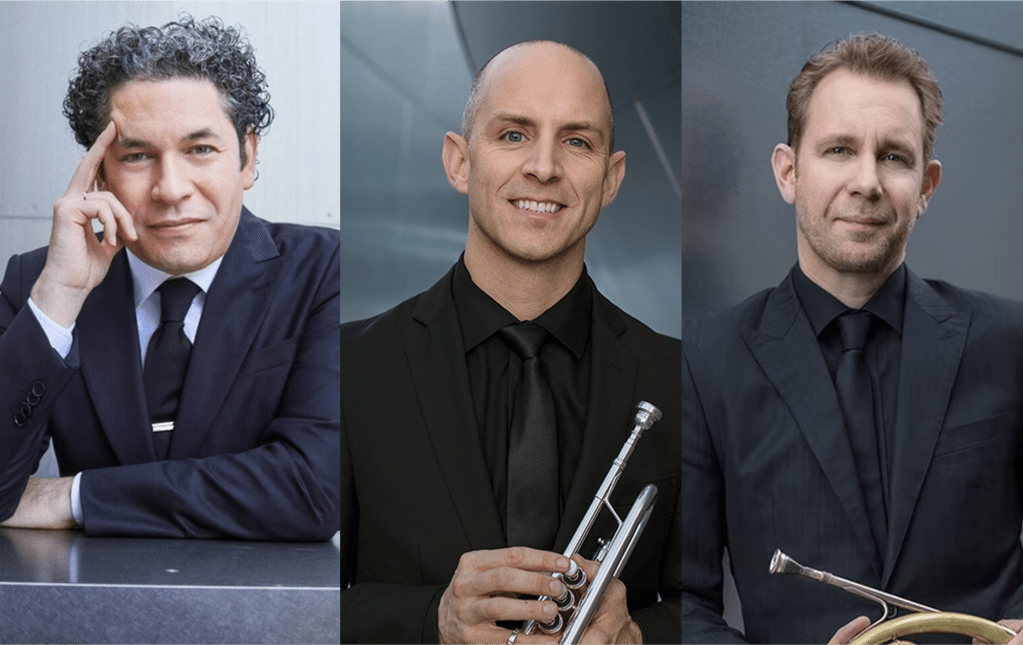
Last Sunday, Gustavo Dudamel and the Los Angeles Philharmonic closed their curiously-named “Mahler Grooves Festival” with a fourth and final performance of a his-and-hers program: Gustav’s Symphony No. 5 and Alma’s Five Songs. The concert proved to be a thrilling way to cap Mr. Dudamel’s latest exploration of the Mahler oeuvre.
The Venezuelan conductor has made a habit of leading Mahler symphonies every season, going back to the 2009 performances of the Symphony No. 1 (“Titan”) that kicked off his tenure as the LA Phil’s Music Director. Those performances were also thrilling but brash, with both tempo and dynamics marked by extreme choices and exaggerated transitions. The same could be said about Mr. Dudamel’s conducting: his arms waved broadly and emphatically, and his feet regularly left the podium. It was a 28-year old’s Mahler: fun, if immature.
With that in mind, this last weekend’s Mahler 5 showed how different—dare I say more grown-up—his approach has become 16 years later. It’s as if Mr. Dudamel, after a decade-and-a-half of playing around with overly fussy fonts and typefaces, has finally come to appreciate conducting with the Mahlerian equivalent of Perpetua: chiseled and elegant by default, enhanced sparingly with the occasional use of italics or underline.
The first movement funeral march was dark and brooding without ever devolving into a slog. Principal Trumpet Tom Hooten set it up with an opening solo that was ominous yet luminous; he had great touch and was virtually flawless throughout, featuring a radiant sound that spun with seeming ease.
The second movement was searing, with Mr. Dudamel’s pacing athletic though never feeling rushed. He gave the third movement scherzo just the right amount of lilt in its bouncier moments, impetus in its churning ones, and reflection in its quieter ones. Principal Horn Andrew Bain was typically excellent in his obligato solos, his burnished sound varying between heroic and melancholy as appropriate.
The fourth movement adagietto was where Mr. Dudamel showed the most growth. In the past, he’d be prone to over-conducting a slow section such as this. Here he allowed it to breathe naturally, taking his time but not letting it get stale. The strings exhibited the warmth they’ve added during Mr. Dudamel’s tenure matched with a high level of precision more common in the Salonen years. The fifth movement finale was joyous. When it was all over, the mostly full Walt Disney Concert Hall roared with approval.
Overall, it was a gutsy performance that still managed much subtlety in timbre and texture. Most notably, Mr. Dudamel gave it more transparency than I’ve ever heard from his prior renditions of Mahler, in particular allowing cellos and woodwinds to shine through clearly in even the thickest passages. The brass soared throughout without ever crushing the other sections. Some might have wanted Mr. Dudamel to be more bold or suave in this portion or that, but I appreciated his choice to show more restraint and let Mahler be Mahler.
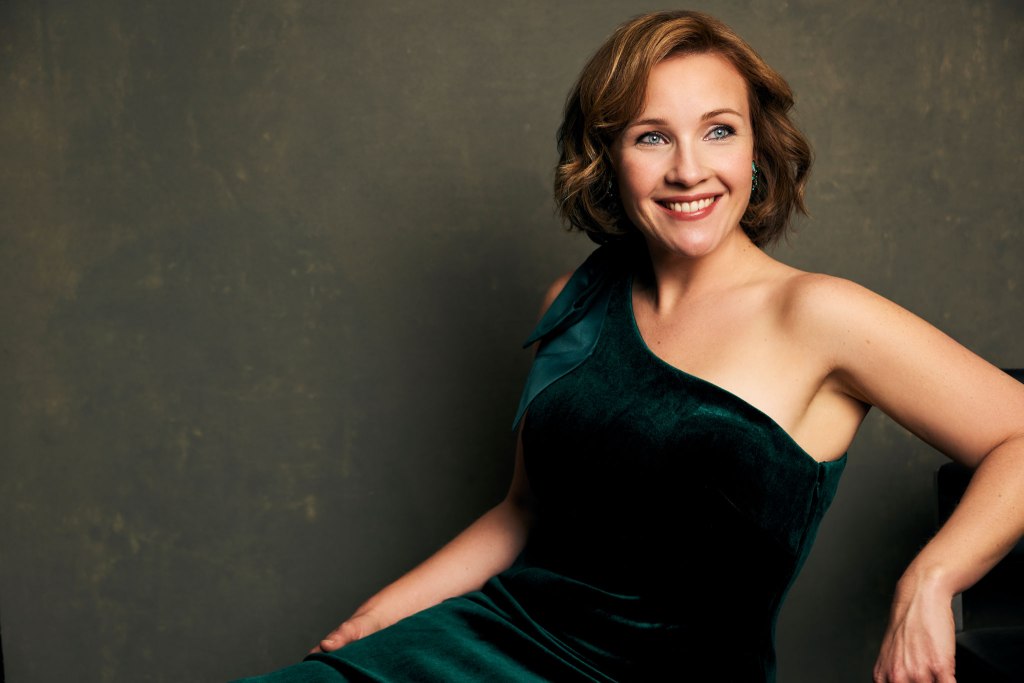
These concerts also offered the first-ever LA Phil performances of Alma Mahler’s Five Songs.
The composer was still Alma Schindler when she wrote the pieces between 1900 and 1901, a time when the relationship with her future husband was blossoming even while she was in an existing relationship composer Alexander Zemlinsky. After they married in 1902, Gustav was not supportive of his wife’s compositions or that she was a composer at all, so the Five Songs and her other music stayed shelved for a decade. It wasn’t until after their marriage survived a rocky point—revelations that Alma was having an affair with future Bauhaus architect (and future father of her child) Walter Gropius—that Gustav finally allowed the Five Songs to be published.
Mezzo-soprano Sasha Cooke was the soloist, trying hard to make a persuasive argument for the songs, and she was reasonably successful. Among the best choices: re-ordering them by moving “In meines Vaters Garten” (In my father’s garden), the longest of the five, from its usual second slot to the end. This gave the collection a grander and more compelling finale than when the much shorter “Ich wandle unter Blumen” (I wander among flowers) typically ends the piece. (Unfortunately, the printed program made no mention of this change, listing the songs in the traditional order; the online program only mentioned the traditional order of the songs in the detailed notes by Amanda Angel.)
Ms. Cooke’s tone was warm and her articulation was clear. She tried to convey the meaning of many lines through overt facial expressions and hand gestures. This was often charming, though she could be excessive at times to the point of pantomime, particularly given the projection of supertitles in the hall. Mr. Dudamel and orchestra gave her ample support, while the orchestrations by David and Colin Matthews allowed her space while adding interesting color.
Random other thoughts:
- During the Mahler 5, choices vary as to where the famous 3rd movement horn obligatos are played by the soloist. I’ve seen musicians play it from the front of the stage standing next to the podium, at the front of the stage standing near the wings, from a dedicated seat in the orchestra immediately in front of and facing the conductor, and from the 1st horn player’s usual seat in the orchestra. For this performance, Mr. Bain stayed in his usual seat, not standing until the big crescendo at Measure 277, and again at a similar passage closer to the end of the movement.
- There were multiple cell phone miscues in the orchestra section of the audience. One audience member had their phone go off in the middle of the Five Songs, with a ringtone approximating carillon bells. Despite one effort to turn off the ringer, it rang again two separate times. After intermission, just as Mr. Hooten was about to play the solo which opens the Mahler 5, another phone could be heard with what sounded like video of somewhat talking about who-knows-what. It wasn’t turned off until many measures later, just as the orchestra joined in. As distracting as they were to the listening experience, they fortunately didn’t seem to distract musicians on stage.
- Among other audience-related matters: the crowd decided to applaud after each of the Five Songs. A smattering of applause could be heard after the first movement of the Mahler 5, but this died down quickly when others refused to join in. Applause returned after the 3rd movement, this time with more participants.
- Given the large number of current and pending vacancies in the LA Phil roster, particularly in titled chairs (and since I’m way behind in providing a “Comings and Goings” update), here’s a quick rundown of who was sitting where and covering what:
- 1st Violins: Principal Concertmaster Martin Chalifour, First Associate Concertmaster Nathan Cole, and Assistant Concertmaster Akiko Tarumoto were all present and in their usual places.
- 2nd Violins: Associate Principal and current acting Principal Mark Kashper was in the first chair for the 5th Symphony. Assistant Principal Isabella Brown was in the first chair for the Five Songs.
- Viola: Associate Principal and current acting Principal Ben Ullery was in the first chair.
- Flute: Associate Principal Catherine Karoly was in the first chair. Principal Denis Bouriakov happened to be playing guest principal with the Berlin Philharmonic.
- Oboe: Mary Lynch (aka Mary Lynch VanderKolk), Principal Oboe of the Seattle Symphony, was the guest first chair for the whole concert. Many readers will recall she was one of the invited final candidates the last time the LA Phil held auditions for its principal chair. She happened to be the only one of the six candidates who I hadn’t yet heard that year. For the record, she sounded solid in these concerts.
- English horn: Russell deLuna played for this concert. He is the English horn of the San Francisco Symphony.
- Clarinet: Andrew Lowy, 2nd/E-flat and current acting Associate Principal played first chair for the Five Songs. Principal Boris Allakhverdyan played first chair for the 5th Symphony, with Mr. Lowy playing E-flat.
- Bassoon: Erik Holtje, Principal of the Delaware Symphony among other posts, played guest first chair for the Five Songs. Principal Whitney Crockett played first chair for the 5th Symphony.
- Timpani: Soojin Kang, USC Thornton grad and incoming Associate Principal Percussion of the Louisville Orchestra, played on the Five Songs. Principal Joe Pereira played on the 5th Symphony. Assistant Principal David Riccobono was not present for either piece.
- Percussion: Wesley Sumpter, frequent guest and former LA Phil Resident Fellow, was the sole percussionist for the Five Songs. Principal Matthew Howard led the section for the 5th Symphony.
Los Angeles Philharmonic: March 9, 2025; Walt Disney Concert Hall
Gustavo Dudamel, conductor
Sasha Cooke, mezzo-soprano
- A. Mahler: Five Songs (orch. by David and Colin Mathews) (listed in order performed)
- “Die stille Stadt” (The quiet town)
- “Laue Sommernacht” (Mild summer night)
- “Bei dir ist es traut” (With you I feel at ease)
- “Ich wandle unter Blumen” (I wander among flowers)
- “In meines Vaters Garten” (In my father’s garden)
- G. Mahler: Symphony No. 5
—————
Photo credits:
- Gustavo Dudamel: courtesy of the Los Angeles Philharmonic Association
- all others: courtesy of the artists’ respective website
 All is Yar
Nice to see you back – as always, well-written review. Just one question: why not a single word about your impression of Alma’s music – its style and quality? Not providing any description and/or evaluation of Gustav’s Fifth Symphony is understandable – most of us know what it is and agree that it is a great work – but hardly anyone is familiar with Alma’s music, so a few words about it would have been interesting to read.
LikeLiked by 1 person
Thanks for the kind words.
Regarding the Five Songs: excellent point and great question. The short answer is I think they’re not bad.
When I first started studying them a few weeks ago, I didn’t dislike them but didn’t find them particularly compelling either. After spending more time with them, they grew on me, particularly “The Quiet Town” and “In My Father’s Garden.” I was looking forward to hearing them live to see if that would change anything. It didn’t.
At this point, I wouldn’t mind seeing/hearing them performed again, but I wouldn’t make a point of it.
LikeLike
Great review, CK. I was blown away by the 5th Symphony and appreciated your analysis. Sasha Cooke gave it her all, yes, but I laughed when I read your overall response to Alma’s songs. “Not bad.” I might also use the word “innocuous.”
Gail
LikeLiked by 1 person
LOL. I might use that word too!
Thanks, Gail!
LikeLike
Thank you for replying. My overall impression was similar to yours. The musical language of the songs seemed to be rather typical “late romantic” of Central European variety, resembling early Gustav Mahler or possibly very early Richard Strauss, but certainly not quite as accomplished and brilliant as those two.
LikeLiked by 1 person