Earlier this week, the Los Angeles Chamber Orchestra released details of their 2026-27 season. It will be their last one with Jaime Martin as Music Director before he steps down and becomes Music Director Laureate. (Incidentally, the prior Music Director, Jeffrey Kahane, had been Music Director Laureate since he stepped down in 2018, and now LACO’s website refers to him with the extra honorary — if somewhat awkward — title of “Music Director Laureate Emeritus” . . . but I digress).
Throughout Mr. Martin’s tenure, he’s crafted varied and persuasive programs and conducted them with insight and panache. It’s been a good run, and it’s a shame that when it’s all done, his time at the helm of the orchestra will have been less than a decade. Having it interrupted by the COVID-19 pandemic makes it seem all the shorter.
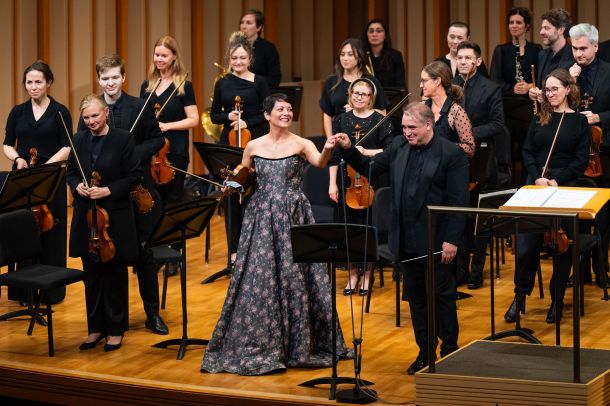
This past weekend’s program at Zipper Hall, a mix of works by living composers and 20th Century masters where he was aided by the formidable violinist Anne Akiko Meyers, was the latest impressive example. The breadth of technical and emotional range Mr. Martin and the orchestra showed in the second half of the concert, juxtaposing Shostakovich’s self-referentially morose Chamber Symphony with Prokofiev’s unabashedly cheery Symphony No. 1, was particularly noteworthy.
The Shostakovich Chamber Symphony, Op. 110a, is an arrangement of his String Quartet No. 8 by conductor and violist Rudolph Barshai. The original work, written in 1960, was publicly declared to be the composer’s reaction to seeing the ruins of Dresden still in place a decade-and-a-half after suffering through heavy allied bombing during World War II. “In memory of victims of fascism and war” was the official inscription.
At the same time, the composer also intended the sorrow-laden work as a requiem for himself, half-joking that no one else would care enough about him to write one. He inserted his own initials throughout (D-S-C-H of the German system being the equivalent of D-Eb-C-B) as a not-so-subtle epitaph. He quoted many of his other compositions liberally: snippets of Lady Macbeth of Mtsensk, the 1st and 2nd Symphonies, the 1st Cello Concerto, the 2nd Piano Trio, and more can be found throughout. It is unapologetically bleak, angry, and at times even snide.
Mr. Martin embraced all of the darkness while managing to illuminate it, and LACO’s strings — Southern California’s most consistent in tonal blend and precision for some time — delivered in spades. He asked them to play in ways that was both bracing and beautiful, and they managed to thread the needle with precision. The effect was sinister yet moving, particularly within the cozy confines of Zipper Hall. Concertmaster Margaret Batjer and Principal Cello Andrew Shulman played their solos with tang.
The First Symphony of Prokofiev that followed it intentionally served as the uplifting palate cleanser. Some conductors take the “Classical” moniker of the symphony as literally as possible, emphasizing its Mozartian qualities. Others lean into the work’s angularities and extremes, foreshadowing the composer’s more mature works. Mr. Martin chose to maximize the work’s exuberance and playfulness. LACO’s woodwinds were particularly spirited, with flutes Ben Smolen (principal) and Sandy Hughes sounding especially charming.

In contrast to the highly divergent works in the second half of the concert, the first half was more consistently elegiac. New works by Juhi Bansal and Eric Whitacre, both reactions to the recent fires in the region, bookended The Lark Ascending by Ralph Vaughan Williams.
Ms. Bansal is this season’s LACO “Sound Investment” composer. She also used to work as a wilderness survival instructor, studying fire cycles and their ebbs and flows vis-a-vis changes in the ecology. Based on that, the orchestra commissioned her to write a work inspired by fire in general, long before the January 2025 infernos caused wide-spread devastation to Southern California, including the many local musicians in Pacific Palisades, Altadena, and elsewhere that suffered grave loss. The composer herself lost her home and everything she owned.
After initially doubting her ability to follow through on the commission, Ms. Bansal eventually co-created it with LACO musicians and completed it on donated piano, staff paper, and pencils. The resulting 15-minute work, Fire Cycle, reflected her recognition of fire’s contrasting impact and her feelings to it: destruction and the anger and grief it causes, followed by rebirth that fire brings to nature and that arises out of people’s attempt at healing.
The resulting world premiere performance was compelling. The three-part work was haunting and arresting: the opening meant to represent “fragile normalcy,” a central section that is jagged and violent, and the finale laden with melancholy tinged with hope. The musicians attacked it with precision backed by palpable emotion. Ms. Batjer and Principal Percussion Wade Culbreath played their solos with intensity.


Next up were two pieces featuring Ms. Meyers. The Lark Ascending, in its most popular incarnation for solo violin and orchestra, was inspired by a George Meredith poem about the titular bird, 12 lines of which the composer wrote at the top of his score. It is Vaughan Williams at his most ethereal. Ms. Meyers’ approach was more gutsy than gossamer while remaining elegant throughout. It extended the sense of resurrection from the close Ms. Bansal’s work.
The West Coast premiere of The Pacific Has No Memory by Eric Whitacre provided the perfect coda to the first half. As the composer described it, “Los Angeles was my home for 25 years. In 2024 I moved to Antwerp with my family, but as fate would have it, we flew to L.A. for a visit on January 8th, 2025. The sky over the Palisades was already smudged black, homes and histories evaporating into the quiet air.”
Because of that, the concept for the piece he had originally planned in response to the joint commission by Ms. Myers, LACO, Orpheus Chamber Orchestra, and Colorado Music Festival was replaced by a new idea inspired by a line from The Shawshank Redemption, one of his favorite movies. Specifically, it lingers on the notion of the lead character dreaming of being “near the ocean where his past is a memory of a memory, distant and liquid – a place where the blue of the Pacific will give him a chance to start new, reborn.”
The final version of the work mirrors that sentiment, with Ms. Meyers and orchestra flowing separately and interdependently. The resulting harmonic convergences and divergences, both musical and and rhythmic, shimmered. The effect was cathartic and calming, a purifying exhale before the audience enjoyed their intermission.
The packed Zipper Hall audience responded to all the pieces with rapt attention and ecstatic applause.
Random other thoughts:
- Mr. Martin spent extended time on the microphone giving commentary about the works, particularly before the second half. The conductor even decided impromptu to have the orchestra demonstrate multiple excerpts, a move he apologized more to the musicians than the audience for not having rehearsed. He’s an insightful and entertaining speaker, and whereas such moves by other conductors can induce side-eyes both in front of and behind the podium, Mr. Martin never fails to draw everyone in.
- The program order printed physically and on LACO’s website had originally showed the Whitacre piece being played before the Vaughan Williams one. The switch was announced before the concert.
- Ms. Meyers signed CDs after intermission at a table adjacent to the Zipper Hall. She was kind and friendly and took her time with everyone who approached her, particularly her younger fans.
RELATED POSTS
- A Zoom chat with Jaime Martin: LA Chamber Orchestra’s Music Director talks about the pandemic, Beethoven 9, and hiring principal players (October 16, 2022)
- REVIEW: Jaime Martin and LA Chamber Orchestra dazzle and inspire in their two-concert return (July 3, 2021)
Los Angeles Chamber Orchestra: April 11, 2026; Zipper Hall at The Colburn School (Los Angeles, CA)
Jaime Martin, conductor
Anne Akiko Meyers, violin
Bansal: Fire Cycle (world premiere, LACO “Sound Investment” commission)
Vaughan Williams: The Lark Ascending
Whitacre: The Pacific Has No Memory (West Coast premiere, LACO co-commission)
Shostakovich: Chamber Symphony for Strings in C minor, Op. 110a (arr. Barshai)
Prokofiev: Symphony No. 1 in D major, “Classical,” Op. 25

—————
Photo credits: Elizabeth Asher
 All is Yar
I used to pop into their lovely concerts now and then in that lovely old converted movie palace in Glendale when I lived in Pasadena… and I always wondered — since LACO can’t possibly be a full-time gig for the musicians(?) — do some/all of them also overlap with the likes of the LA Opera, Pasadena, Hollywood Bowl Orchestras, etc?
LikeLike
The short answer is, in general, yes. LACO was founded in the late 1960s as an outlet for studio musicians to play classical music that the LA Phil wasn’t covering and/or suited for. It was always intended to be a part time gig. These days, many of them still play in the studios even though that work is not nearly as robust as it used to be. Others play in other orchestras and not just local ones (e.g. the Principal Bass, David Grossman, is in the NY Phil) and/or teach.
Read the end of this story to see how 5 LACO musicians (3 of whom are still in the orchestra) view and handle the part-time nature of the orchestra: https://allisyar.com/2017/05/18/the-end-of-the-kahane-era-five-laco-musicians-look-back-on-the-music-directors-20-year-tenure-and-ahead-to-what-comes-next/
LikeLiked by 1 person