Is “The Gospel According to the Other Mary” mis-named?

I’m killing time before this evening’s Los Angeles Philharmonic concert by drinking an old fashioned — a really good one, BTW, care of the bartender at the Omni Hotel near Walt Disney Concert Hall.

Anyways, I started thinking about tonight’s world premiere of The Gospel According to the Other Mary, a modern bit of social commentary-cum-oratorio by John Adams told from the point of view of Mary Magdalene.  So I’m guessing “the other Mary” is a reference to the protagonist, identifying her as a different Mary than the mother of Jesus.

Now I’m no bible scholar, but I’ve spent some quality time in church on Sundays, not to mention spending a few formative years of my youth being taught by nuns (God bless the Daughters of Mary Help of Christians). And one thing I know is that despite all the confusion about the various women named Mary in the bible (a confusion which, according to the program notes, the libretto allegedly avoids), there actually is a woman referred to as “the other Mary” — and she is NOT Mary Magdalene.

Kinda reminds me of the issue some people (like me) had with the title of  The Da Vinci Code and how it would have been more proper if it were called The Leonardo Code. Yeah, I also get annoyed when people say “very unique.”

Of course, there is one other thing that John Adams’ musical piece and Dan Brown’s book share: they are works that start with Christian-related subject matter, but in actuality are entirely non-Christian . . . or perhaps extra-Christian.

As long as we all know this going in and treat it as such, we’ve put it in the right context.

I’m out of bourbon-based refreshment and should really get over to WDCH instead of getting another round.  Feel free to discuss more amongst yourselves.

Review of tonight’s concert coming in a day or so.

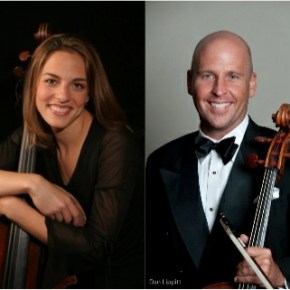
Who’ll be the next LA Phil Principal Cello? Two finalists emerge

The Los Angeles Philharmonic recently held auditions to find a new Principal Cello to replace Peter Stumpf, whose name still appears on their roster as being “On Leave” but who hasn’t been with the orchestra all season.  The required repertoire list for the audition included some excerpts that would be expected (Haydn Concerto, Don Quixote, La Mer) and some others that are a bit less expected (Mozart String Quartet, City Noir).  After multiple rounds of playing, two players emerged from behind the screen as finalists:  Julie Albers and Robert deMaine.

By all accounts, they are two very good cellist.  Neither has a prior connection to the orchestra.  They both have experience as soloists and chamber musicians.

Despite those similarities, there is one big difference:

Read more of this post

On Memorial Day, a musical tribute to those who died wearing the uniform

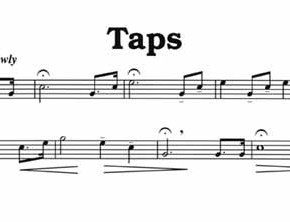
Twenty-four notes.  Among the most recognizable twenty-four notes in America, regardless of genre of music one usually listens to.

The history for this bugle call goes back to the Civil War.  If one has spent time in any branch of the United States military, you’d most commonly hear Taps played to signal the end of the day, the official “lights out” notification.  For almost everyone, however, the plangent sound of Taps is most familiar for being played in memory of those who have fallen in the service of their country.

There is some debate about whether the repeated G-C-E in the third and fourth measures are played eighth/eighth/quarter note as written above, or as dotted-eighth/sixteenth/quarter note as appears on other versions of the sheet music.  There is also some debate on whether it is better or preferred for Taps to be played by a single bugler or by two in so-called Echo Taps  arrangement.

That said, I think I can safely say that there is no debate about the impact Taps (or Echo Taps) has when played live at a military funeral or other memorial service.  I can think of no more appropriate musical tribute to the men and women who have lost their lives in the service of this great country than these simple twenty-four notes.

So before you fire up the BBQ grill today, and regardless of your political leanings, say a prayer of remembrance and take less than a minute out of your day to listen to (and/or download for free) one or both of the following MP3′s (care of the United States Air Force Heritage of America Band (FKA the USAF Tactical Air Command Band) based in Langley AFB, Virginia).

  • Taps (solo bugle) — click HERE
  • Echo Taps (two bugles) — click HERE

Happy Memorial Day.

LA Phil’s history with Mozart’s Posthorn Serenade

Following up regarding my last post about Friday night’s Los Angeles Philharmonic concert, here’s one extra little tidbit about Mozart’s Posthorn Serenade and the orchestra:

  • As stated in both printed and online version of the program notes, the first performance was March 26, 1942, with George Szell conducting.
  • Until this season, the most recent performance was one day later, March 27, 1942, again with Mr. Szell on the podium.

I realize that this serenade isn’t exactly regular fare, but I was a bit surprised to know that it hasn’t been played by the local band in over 70 years!  I guess this qualifies as a forgotten gem of sorts, at least around these parts.

Related post:

Nothing casual about this Mozart: Kiera Duffy joins Gustavo Dudamel and the LA Phil

It wasn’t supposed to be an all-Mozart program.  What was originally announced as a Tchaikovsky/Sibelius program morphed a couple of times over the course of this season before landing on its final form.  One of the subscribers wasn’t happy about all the repeated changes and made her opinion known during the “Casual Friday” post-concert Q&A.  With a sense of annoyance and exasperation, she asked, “Doesn’t anyone know what’s going on?”

It was an uncomfortable moment.  Luckily, among the panelists on stage taking questions was the person best equipped to provide an answer:  Gustavo Dudamel.  With his good natured style, he made no effort to soft-pedal his response and instead took the question head on.  He explained that the Sibelius 5th Symphony means a great deal to him (he conducted it in his first concert with one of his other orchestras, the Gothenburg Symphony); however,  it made more sense to surround the Los Angeles Philharmonic’s performance of Mozart/DaPonte operas with Mozart Serenades.  Next year, it’ll be The Marriage of Figaro and the Haffner Serenade (though in the currently published version of the LA Phil’s 2012/13 season, it doesn’t show up).  For this year, they settled on pairing Don Giovanni with the Posthorn Serenade.

His style in responding to that question perfectly reflected the style with which he approached the two Mozart works on the program:  good natured but head on.

Read more of this post

Free new music concert for veterans tonight

Tonight is the final concert of Southwest Chamber Music’s LA International New Music Festival.  In honor of Memorial Day and the men and women who have worn the uniform, Southwest is offering free admission to veterans.

The concert at Zipper Hall at the Colburn School begins at 8pm, with a free 7pm pre-concert discussion with the concert’s composers, Alexandra du Bois, Vu Nhat Tân, and Gabriela Ortiz, moderated by Martin Perlich.

The program includes:

Gabriela Ortiz:  Rio Bravo (U.S. Premiere)
Tôn Thât Tiêt:  Miroir, mémoire (World Premiere)
Alexandra du Bois:  Night Songs (LA Premiere)
Vu Nhat Tân:  The Song of Napalm (World Premiere)

Southwest Chamber Music’s promising new festival

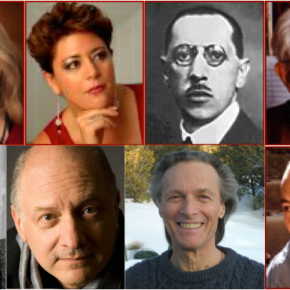
Top Row: Anne LeBaron, Gabriela Ortiz, Igor Stravinsky, Elliott Carter
Bottom Row: Milton Babbitt, Daniel Catan, Peter Lieberson, Vu Nhat Tan

A four-concert event called “The Inaugural LA International New Music Festival” certainly sounds like a big deal.  You can forgive Southwest Chamber Music for giving their nascent new music series such an official, highfalutin’ sounding name.

With the city’s long-standing reputation as an incubator of new music and home to many prominent composers, you’d think an event with such a name would have been created by someone else at some point in the past.  It wasn’t.   You might also assume that it’d receive attention, support, and advanced publicity from the major local paper.  It hasn’t.

You might also think you’d get a mix of living composers from around the globe.  You didn’t — at least not yet.   I’m sure that if Jeff von der Schmidt, Southwest’s Artistic Director, has his way, the Festival will continue to grow in scope and stature, filled with premieres by composers from every continent.  The vast majority of composers consisted of Americans (North and South) and Asians, with world premieres from Korean-American composer Hyo-shin Na and Vietnamese composers Vu Nhat Tân and Tôn Thât Tiêt.  For now, the Old World contingent was represented by Schoenberg and Stravinsky, who I’d consider just as much Angeleno as European.

On Monday night, the third concert of the series featured a collection of compact works for a mix of instruments and voice.  They represented a fairly broad range of musical styles, some more accessible than others, though none of which were particularly thorny relative to the most avant-garde new music or even the works of John Cage which Mr. von der Schmidt so proudly champions.  It ended with a veritable jam session featuring Southwest and guest musicians, utilizing a mix of Western classical music instruments, traditional Vietnamese instruments, and electronic enhancements.  The whole experience was fascinating and rewarding, and made me wish I could have attended the previous two concerts.

Read more of this post

Glenn Dicterow to leave NY Phil and join USC Thornton

As if there hasn’t been enough big, crazy musical news out of New York this week, the announcement came earlier today that Glenn Dicterow, Concertmaster of the New York Philharmonic since 1980, will join the faculty of the USC Thornton School of Music in Fall of 2013 and then step down from his NY Phil chair at the end of the 2013-2014 season.  He will become the first ever “Robert Mann Endowed Chair in Violin and Chamber Music.”  He currently teaches at the Juilliard School.

It is a homecoming  for Mr. Dicterow.  He grew up in Los Angeles as his father, Harold Dicterow, was the longtime Principal Second Violin of the Los Angeles Philharmonic.  The younger Mr. Dicterow was himself recruited to join the LA Phil by former Music Director Zubin Mehta and eventually rose to the position of Concertmaster.  Soon after Mr. Mehta left Los Angeles to take the same post with the NY Phil, he offered that orchestra’s Concertmaster chair to Mr. Dicterow, who has been a fixture there ever since.

Mr. Dicterow will be joined on the USC Thornton faculty by his wife, Karen Dreyfus, a viola player and teacher at the Juilliard School and the Manhattan School of Music.

For more information:

  • The USC Thornton School of Music press release HERE
  • The New York Philharmonic’s press release HERE
  • Story in the Los Angeles Times HERE

Go big or go home: an ambitious Don Giovanni staged by the Los Angeles Philharmonic

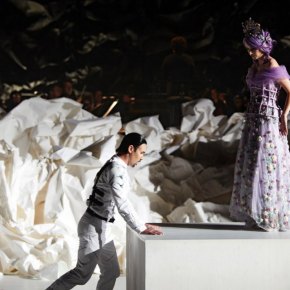
It was not your average Sunday afternoon at Walt Disney Disney Concert Hall.  Gustavo Dudamel was still on the podium for the Los Angeles Philharmonic’s unofficial Mozart Month, but that was pretty much where “business as usual” ended.  The LA Phil had decided that their first-ever complete performances of Don Giovanni would be full-blown productions, not mere stand-and-sing concert versions of Mozart’s opera.

As if that weren’t enough, they:

  • hired Frank Gehry, the designer of Disney Hall and most famous living architect on the planet,  to create the setting
  • populated it with a young, attractive, and vocally strong cast led by Mariusz Kwiecien, one of the most prominent Dons currently around
  • dressed them in costumes designed by Kate and Laura Mulleavy of the noteworthy Los Angeles fashion house, Rodarte
  • handed the whole thing over to Christopher Alden, a director known locally for interesting operatic interpretations

The result was high in style and substance, sounding very good and looking stunning.  It wasn’t a complete triumph, with some aspects which were quirky and frustrating, but you had to appreciate and be impressed by the overall effort. Read more of this post

Anticipating the Don

I’ve been looking forward to attending the Los Angeles Philharmonic’s fully-staged Don Giovanni for a number of reasons:

  • First of all, well, because it’s Don Giovanni and who doesn’t want to see and hear that under pretty much any circumstance?
  • The appearance of Mariusz Kwiecien in the title role.  It’s been a very good season for baritones in L.A. so far (let’s see:  Thomas Hampson, Vitalij Kowaljow, Mathias Goerne, and just for good measure, let’s throw Placido Domingo in there too).  Mr. Kwiecien is the latest in that distinguished line.
  • Frank Gehry’s set design and Rodarte (Kate and Laura Mulleavy) costumes.  I’m a huge fan of Mr. Gehry and have been intrigued by what I’ve seen from the Mulleavy sisters.  Though the initial sketches of set and costumes looked typically vague, the pictures released by the LA Phil look quite interesting — because of the designs, and also because of the curious lack of clarity on where the orchestra is seated.
  • What will Gustavo Dudamel do with this score?  Whereas Esa-Pekka Salonen favored the music of Haydn when he was in a Classical period mood, Mr. Dudamel clearly favors Mozart.  His past interpretations of his works  tend to be big and bold:  thrilling, but a bit more heavy-handed than I’d prefer my Mozart to be.  Of course, those have been symphonies and smaller scale orchestral works, and a full-blown opera is a different story.

The four-performance run opened last night, but I’m not going until tomorrow — and all of the above combine to make it worthwhile to brave the threat of impending Downtown LA traffic craziness to rival Carmageddon, not to mention missing the potential series-sweeping LA Kings game.  Of course, if this were the Stanley Cup finals, I’d have picked a different concert date . . . but more often than not, watching music being performed live trumps watching sports on TV.

My review will be posted Monday morning.  Stay tuned.

—————

Photo credit:   Autumn de Wilde (Los Angeles Philharmonic)

Anniversary of Bernstein’s last day as NY Phil Music Director

Care of the folks at Composers Datebook at American Public Media:

On today’s date in 1969, Leonard Bernstein conducted his last concert as the Music Director of the New York Philharmonic. Bernstein had been named the orchestra’s Music Director in November of 1957, and was the first American-born and trained conductor to hold the position.

So for baseball fans, these were Bernstein’s “stats” as of May 17, 1969: He had conducted 939 concerts with the orchestra, more than any other conductor in its history. He had given 36 world premieres, 14 U.S. premieres, 15 New York City premieres, and led more than 40 works never before performed by the orchestra.

To listen to the Composers Datebook  program streaming online, click HERE.

It’s not a competition, but just for comparison, here are Esa-Pekka Salonen’s stats after his 17 year tenure as Music Director of the Los Angeles Philharmonic ended in 2009:

  • Commissioned over 54 new works
  • Conducted 120 world and U.S. premieres
  • Served as music director longer than anyone else in the orchestra’s history, leading the orchestra in 973 concerts and 23 tours.
Just to add one more parallel:  upon retirement, Mr. Bernstein was given the title of “Laureate Conductor” and is still officially listed by the NY Phil as such; Mr. Salonen was given the title of “Conductor Laureate” the last day he was the LA Phil’s Music Director.

—————

Photo credit:  Bob Cato (www.leonardbernstein.com)

One way to judge a conductor

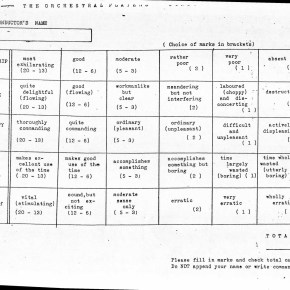
A week or so ago, I was having a discussion with a distinguished reader of All is Yar about evaluating conductors, and I was reminded of a rather amusing conductor rating survey that was circulated a few years back among members of an organization of which I was a part.  The form itself was not used by us, but rather by some unknown orchestra, apparently located in European.  Judging by the font and design, I’m guessing it is a few decades old or someone took great pains to make it look that way.

It’s not exactly a textbook design for a survey:  for example, it really makes no sense to give the best categories an eight-point range of 20-13 while only allocating a single point to each of the bottom three categories.

That said,  the descriptions employed by its author are  pretty freakin’ funny nonetheless.  I can think of all the conductors under which I’ve performed and which descriptions I’d apply to them.  A couple of my favorites:

  • In “Personality:”  The distinction between “ordinary (pleasant)” and “ordinary (unpleasant)”
  • In “Rehearsal Ability:”  The case of a conductor “accomplishing something but boring”
As always, your own thoughts and comments are welcome and appreciated.
(Click on the image below to see it full-sized)

A familiar voice expands his reach

Brian Lauritzen — radio personality extraordinaire, under-appreciated cellist, and friend of All is Yar — is known primarily for his smooth, easy-going voice on Classical KUSC (that’d be 91.5FM for all of you who still listen to terrestrial radio in Southern California), as well as podcasts for the Los Angeles Chamber Orchestra, Los Angeles Opera, and Concrete Voices.   But you know, that isn’t quite enough, is it?

Mr. Lauritzen has now joined that elite cadre of those blogging about life and classical music . . . okay, wait, that’s not entirely accurate.  He’s been blogging for a while, just on other people’s sites.  Now, he’s finally got a place on the interwebs that he can call his very own, conveniently titled “Brian Lauritzen” and found at www.brianlauritzen.com.

Among his many past and current accomplishments and honors, he can now include onto his resume his status as a privileged member of the All is Yar blogroll.  Congratulations, Mr. Lauritzen.

Incidentally, if you want to hear some of Mr. Lauritzen’s handy work hosting the Los Angeles Philharmonic’s weekly broadcasts on KUSC, click HERE to catch the program streaming online.   This week happens to feature the concert from earlier this season with Esa-Pekka Salonen conducting the world premiere of  Shostokovich’s Orango and the same composer’s Symphony No. 4 (my own thoughts from that concert HERE).  Besides the benefit of getting to hear Mr. Lauritzen host an awesome concert, you get the additional bonus of not having to endure Peter Sellar’s exceedingly tedious videos shown in Walt Disney Concert Hall during the live performances.

RELATED POST:

—————
Photo credit: classicalkusc.wordpress.com

Justifiably popular: the latest vibrant young cast inhabits Los Angeles Opera’s classic “La Bohème”

Mimi (Ailyn Pérez) and Rodolfo (Stephen Costello) go shopping for a bonnet

Giacomo Puccini’s La Bohème is as popular and reliable a seat-filler as you can get in opera.  In Southern California alone, it has been programmed by both the Pacific Symphony and Los Angeles Opera within weeks of each other this spring.   It shows up so often that opera-going veterans see La Bohème on the calendar and grumble and moan something like, “Ugh, not again,” the way the rest of the world wanted to throw something at speakers after the umpteenth rendition of “Pumped Up Kicks” polluted every clean parcel of broadcast airspace last summer.

One could therefore be easily lulled into a “been there, done that” attitude when this warhorse showed up on LA Opera’s season.  That attitude may have been exacerbated with the knowledge that this is the sixth time the same production is being used by the company, and that the company’s Music Director isn’t going to be in the pit.

If that’s the way you feel, fight it and avoid the temptation to skip this production.   If Wednesday night’s preview (see below*) is indicative of the run, there is everything to like about this Bohème:  a beautiful production, staged intelligently, and populated by a talented young cast.

Read more of this post

Live tweeting “La Bohème” tonight


I’ll be back in a Los Angeles Opera “Tweet Seat” for tonight’s final dress rehearsal of La Bohème. If you’re already on Twitter, you can follow along my observations along with those of the rest of the Tweet Seat crew (and even perhaps some of the opera cast) with hashtag #LAOBoheme.

If you’re not already on Twitter, you can click on the “Follow @MrCKDH” button on the right, or you can see my updates in the Twitter window (just hit your browser refresh button from time to time to get stay up to date.

%d bloggers like this: