The inaugural edition of “All is Yar’s Most Favorite and Noteworthy Classical Music Stuff of the Year”

clapAs we reach the end of December, it’s traditionally time for a retrospective look at the year that is just completed.  Since 2012 was the first full calendar year of All is Yar‘s existence, it’s an especially important one for me.  I’ve been fortunate — dare I say “blessed” — to have been able to experience more performances than I would’ve guessed at the beginning of the year — most of them somewhere between really good and truly awesome.

After some very detailed number-crunching,  extremely scientific analysis, and deeply meditative internal reflection (OK, maybe more like some quality time with a green tea and some scotch), I decided to follow tradition and write-up a list of stuff I thought was worth mentioning.  So cozy up to a loved one, grab a glass of your favorite beverage, and get yourself ready for  . . . (cue trumpet fanfare) . . . the first-ever  ”All is Yar‘s Most Favorite and Noteworthy Classical Music Stuff of the Year”.

Best Orchestral Performance:  Simon Rattle conducting the LA Phil in works by Ligeti, Wagner, and Bruckner

  • Sir Simon led a performance so gripping, so absolutely awesome, it didn’t even matter that the concert featured three of my least favorite composers.

Favorite Concert(s) of the Year:  The Rite of Spring, a new Symphony from Steven Stucky, and some Bernstein to boot (Los Angeles Philharmonic, Gustavo Dudamel conducting)

  • First of all, we’re a talking Le Sacre du Printemps here, pretty much my favorite orchestral work ever.  Secondly, the performance by the Mr. Dudamel and the LA Phil was as good as I’ve heard from that combination, so good in fact that I had to see it twice (hence the parenthetical plural “Concert(s)” above).  Third, we got the added bonus of a bright new work from Mr. Stucky.  Fourth, did I mention the concert included Stravinsky’s  The Rite of Spring, which is pretty much my favorite orchestral work ever?

Best Performance of a Work I Don’t Need to Hear Again for a Long, Long Time:  Riccardo Muti and the Chicago Symphony do Franck’s Symphony

  • Really, CSO??  You don’t come to Southern California for more than a generation, and this is what you bring along?!!  I mean, it sounded great and all, but . . . come on, man!

Read more of this post

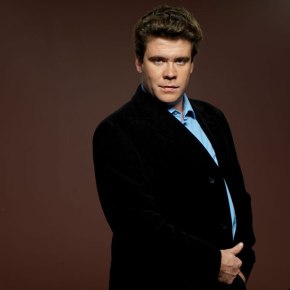
Youth is served: Krzysztof Urbański and Denis Matsuev make their LA Phil debuts

The Hollywood Bowl is often a place for conductors and soloists to make their Los Angeles Philharmonic debuts.  It’s a bit of trial by fire — if you can make a strong impression under the duress of limited rehearsal time and less-than-ideal performing conditions, then you might get invited for a gig downtown for the “regular” season.

Conductors seem to have the higher risk/reward profile in this environment.  Gustavo Dudamel and Simon Rattle are just two conductors who had noteworthy starts to their relationship with the LA Phil at Cahuenga Pass.  The less heralded Juraj Valčuha acquitted himself well enough in a one-night Hollywood Bowl stint in 2009 to get invited back to work with the orchestra and Yefim Bronfman in 2011.  In contrast, Kirill Karabits led two concerts during the same 2009 summer season and hasn’t been seen or heard with the local band since then.

Into the breach this past Tuesday stepped conductor Krzysztof Urbański and pianist Denis Matsuev.  They each left strong impressions in their own very different ways, both having mixed results.

Read more of this post

Shamelessly enjoying “Carmina Burana” at the Hollywood Bowl

Classical music, like life in general, abounds in so-called guilty pleasures.  You know, the kind of stuff that you may not admit to friends that you like, but in the privacy of your own iPod earbuds, you relish with abandon.  Warsaw Concerto is one for me.  Carmina Burana is another one.  Not a whole lot of people know Warsaw Concerto, but everyone knows Carmina Burana, whether they actually realize that they know it or not.  It is this relative ubiquity that makes “serious” musical fans scoff Scoff SCOFF when Orff’s cantata shows up on programs.

“Spend your time listening to something deeper, more profound.  Like the Mahler Eighth Symphony,” an uber-intellectual friend once told me.

As it turns out, I like to think of Carmina Burana as the Mahler Eighth’s evil twin:  both split their libretto between Latin and Deutsche, both start with a booming chord in the orchestra followed by a grand entrance by the chorus, and both benefit from being done big.  Of course, where the Mahler Eighth is all radiance and redemption, Carmina Burana is decadence and debauchery.  Mahler has the Virgin Mary, Orff has the drunken “Abbot of Cockaigne.”

There is a time and place for both.

Last Thursday was the time, and the stage beneath the oversized white arches of the Hollywood Bowl was the place for the churning, chugging sounds of Orff’s paen to the whims of fortune and the joys of gluttony, drink, and lust.  The performance benefitted from some standout soloists, smooth and energetic ensemble work by the Los Angeles Philharmonic, the Los Angeles Master Chorale, and Los Angeles Children’s Chorus, all managed by the capable hands of Rafael Frühbeck de Burgos.

Read more of this post

Four hands and a voice: Southwest Chamber Music’s final 2012 summer concert

The final concert of Southwest Chamber Music’s 2012 summer season at The Huntington proved to be a popular ending to what has been a popular series.  Attendance on the Logia was overflowing to the point where an extra row of seating was hastily added right as the concert was about to begin.

As with the other three concerts in a series centered around French music, Ravel and Debussy featured prominently, this time appearing via music for piano duets.  Works by Manuel de Falla and Darius Milhaud rounded out the “classical” works on the bill, with songs made famous by Édith Piaf closing out the evening.

Unlike the previous Southwest concert which featured exotic music and atypical instrumentation, this program offered very little to challenge the audience, with a literally hum-along finale underscoring the entire concert’s easy-going sensibility.

Read more of this post

Brava, Ms. Balsom! Trumpeter dazzles at the Hollywood Bowl

You hear of a night of Haydn conducted by the ever-sunny Nicholas McGegan, and you probably think, “That’s nice.”  You notice that the Haydn Trumpet Concerto will be the centerpiece of the evening and you might say, “Hmmm, haven’t heard that performed in a while.”   You realize that Alison Balsom is the trumpet soloist, and you drop whatever you had planned and you go.

At least that’s what you should have done Tuesday night, but you probably didn’t.  And that’s a damn shame.

Judging by the relatively sparse attendance at the Hollywood Bowl, you weren’t the only one.  Haydn apparently isn’t the draw that Beethoven or Mozart or Tchaikovsky is.  Perhaps the sheer volume of his output waters down any individual work’s popularity, making an all-Haydn night less compelling to the masses.  But if there’s one work that should stand out, it’s the trumpet concerto.  Written as a showpiece for an instrument that in the composer’s time had just recently evolved to be able to play a full chromatic scale, it is compact, lyrical, virtuosic — what’s not to love?

Part of the problem is that we just don’t hear it live often enough.  As trumpet concertos go, the Haydn is bread and butter, but compared to concertos in general, it may as well be foie gras:  rich and juicy, comes in small portions, damn hard to find.

If memory serves, the last time the Los Angeles Philharmonic performed it was in 1995 when former Principal Trumpet Thomas Stevens was the soloist.  In that time, there have been multiple performances of relative rarities like the Lutosławski cello concerto, the Korngold violin concerto, and Rodrigo’s Concierto de Aranjuez for guitar — don’t even get me started on the Lady Gaga-ish ubiquity of the “Rach 3″ or the Mendelssohn violin concerto.   But I digress . . .

On top of all this, you get Alison Balsom.  If there’s a star among classical trumpet virtuosos these days, she is it (and, no, I don’t count Wynton Marsalis since he doesn’t really play classical music anymore . . . OK, maybe you’ve got an argument if you bring up Håkan Hardenberger, but still . . . ).

Read more of this post

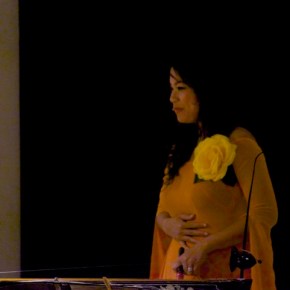
An exotic addition to a French summer at the Huntington: Southwest Chamber Music plays Debussy & Ravel, and invites back a Vietnamese virtuoso

Inspired by the centennial of Pasadena-native, Julia Child, Southwest Chamber Music has been focusing  on French music for their Summer Festival 2012 at The Huntington.  Healthy portions of Debussy and Ravel are offered up in each concert.  This past weekend’s programs, the third in the series, paired those two quintessential French composers with works from Vietnam.

It was a natural twist.  Not only have the two cultures long been intertwined due to colonial influences, Southwest has made an ongoing effort to build a relationship with and champion Vietnamese musicians, most notably through the 2010 “Ascending Dragon” Music Festival and Cultural Exchange in conjunction with the U.S. State Department (the largest ever of its kind)  and their inaugural “LA International New Music Festival” held just a few months ago.  Moreover, the music of both Debussy and Ravel is filled with Eastern influences.

That mix of music, combined with the rather balmy evening and views of palm trees in the distance peeking through behind the performers, gave the whole affair an appropriately tropical, exotic feel to it.  As Momma once famously declared, “The night was sultry.”

Read more of this post

Style and substance in equal measure: Wang joins Dudamel and the LA Phil for some Tchaikovsky

Tchaikovsky concerts at the Hollywood Bowl are common occurrences.  Thursday night’s Los Angeles Philharmonic concert was pretty typical, with a program featuring a pair of frequently heard warhorses:  the Piano Concerto No. 1 and the Symphony No. 4.

Then again, in some ways, this wasn’t all that typical.  There were no fireworks, no 1812 Overture, no USC Trojan Marching Band.  Instead, we got Gustavo Dudamel conducting and Yuja Wang playing the piano.  I’d say that’s more than a fair trade.

Some people may not agree, though.  Both Mr. Dudamel and Ms. Wang  benefit/suffer from marketing machines and media attention focusing on things not directly related to their music making.  This leads to claims that either or both are over-hyped, triumphs of fluff over stuff, all show and no go.

Sure, image is a big part of each of their personas.  But don’t believe the naysayers.  Whatever one may think of their style, there is at least as much substance, if not more. Both of them are musicians who already offer some exciting and probing interpretations of major works despite their relative youth.

Thursday night was the latest example of this.  While the performances were not flawless, they were compelling — they didn’t try too hard to make a big impression, nor were they content to settle for the ordinary or cliché.

Read more of this post

NEWSFLASH: CKDH actually manages to enjoy some Brahms, care of Fima Bronfman, Lionel Bringuier, and the LA Phil

I have more than a few things to say about last Tuesday’s Los Angeles Philharmonic concert at the Hollywood Bowl, as usual.  But let’s get one thing out of the way, shall we?

Yefim Bronfman is a bad-ass.

Ok, perhaps this is old news, but even if that’s the case, it’s worth repeating.

So many reasons why this is true, not least of which because he happened to break his finger in the midst of playing the Prokofiev Sonata No. 8 last year — and still managed to play through the pain and finish the concert (read Rick Schultz’s very nice interview with him HERE where he discusses his broken finger and subsequent recovery).

Broken finger or not, Mr. Bronfman (AKA “Fima”) never ceases to amaze with his combination of refined taste, superior musicality, impeccable technique, and ferocious power that he wields like an AC-130 gunship — staying in the background until called for, at which time thunder is unleashed and woe be to those who dare get in the way.

To use another analogy, he treats piano works like Walter Payton treated defenders:  as appropriate, he can speed around them, he can pound right through them, or he can bob and weave his way through a thicket of obstructions — always making the right choice for the moment, and always with grace and class and dignity.

All of that is true on any given night, but last Tuesday, he managed to pull off something rather remarkable:  he managed to get me to truly enjoy a major work by Brahms.

Read more of this post

Le Hollywood Bowl avec un accent français: Denève, Thibaudet, and the LA Phil revel in a Franco-American program

When it comes to standard musical fare at the Hollywood Bowl, it’s tough to come up with two composers more iconic than George Gershwin and Leonard Bernstein.  Besides having their music performed pretty much every summer in the Cahuenga Pass, the two Americans have other close ties to the Bowl:

  • The 1937  memorial concert commemorating Gershwin’s too short life was famously broadcast from the Hollywood Bowl, and featured the Los Angeles Philharmonic with a whole host of performers, likely and unlikely, who came to honor the man who first merged jazz and classical music.  (BTW:  the recording of the concert is a must-have, and includes all sorts of good stuff, including a quirky transcription of the Piano Prelude No. 2 conducted by Otto Klemperer, the LA Phil’s music director at the time.)
  • Bernstein spent a few summers conducting at the Bowl, most notably as one of the founders and artistic directors of the now-defunct Los Angeles Philharmonic Institute.

So seeing their music on last Thursday’s program, along with works from Gershwin’s French contemporary, Maurice Ravel, seemed de rigueur — at least at first.  Leave it to conductor Stéphane Denève to put a slightly different spin on the night:  the theme would be Americans influenced by the French, and French influenced by Americans.  Just for good measure, he brought along French pianist and Los Angeles resident, Jean-Yves Thibaudet.

The Marquis de Lafayette, Josephine Baker,  Frédéric Bartholdi, and Jerry Lewis would have undoubtably approved of the sentiment.  I certainly approved of the outcome.

Mr. Denève proved to be charming, both in his remarks from the stage and in his musical interpretations.  The LA Phil sounded quite nice, with many notable solos being contributed by players within their ranks.  Mr. Thibaudet knocked the stuffing out of a concerto that was right in his wheel house.  Even the Bowl’s temperamental A/V system mostly behaved.  There was much to enjoy, and very little to fuss about.

Read more of this post

Going out with style: Tokyo String Quartet bids a fond farewell to Chicago

This past Tuesday, the Tokyo String Quartet played what first violin Martin Beaver said would almost certainly be their last concert at the Ravinia Festival.  In all likelihood, it will also be their final appearance anywhere in the Chicago area.  With Kazuhide Isomura (founding viola)  and Kikuei Ikeda (longtime second violin) deciding to retire, the whole ensemble is calling it quits after the 2012/2013 season.  It was “an evening full of meaning for us,” according to Mr. Beaver.

That I was there to experience it was a confluence of lucky events.  A week before, I didn’t know I’d be in Chicago.  The day before, I wasn’t sure if I’d be attending.  That morning, a massive thunderstorm rolled through the region, complete with hail and some not-messin’-around wind causing widespread damage and some power outages.

Around lunch time, the rain stopped, but I got a weather alert on my phone warning of “Severe Heat” with temperatures between 100 and 104 degrees with a heat index of up to 110 degrees once you factored in the humidity;  however, this turned out to be a warning for Wednesday, not the night of the concert  By the time I arrived at Ravinia around 6:30pm, the skies had cleared and the temperature was a very SoCal-like mid-70′s with moderate humidity.  Nothing would get in the way of the chance to see this concert.

Lucky me — and very lucky, too, for the near-capacity crowd inside Martin Theatre and the many others picnicking outside.  The Tokyo Quartet treated everyone to an evening that was enjoyable on so many levels.

Read more of this post

Of wine and white jackets, composing women and killer whales: the start of the 2012 Hollywood Bowl season

Composers Anna Clyne, Anne LeBaron, and Cindy McTee

It was time for musicians to break out their summer whites and for the audiences to try to not roll empty bottles of wine down concrete steps.  That’s right:  I’m talking about summer at the Hollywood Bowl.

After a few concerts of playing back-up band to Barry Manilow, the Los Angeles Philharmonic opened the classical music portion of the 2012 summer season last Tuesday in an unlikely fashion:  playing three works written by living composers — living female composers, no less. If you throw in two concerts of playing the world premiere of George Fenton’s Frozen Planet in Concert, this was a non-trivial amount of new music that the orchestra had to digest.

Granted, it wasn’t as a big a challenge as, say, playing Don Giovanni and The Gospel According to the Other Mary in short succession, but it’s not like the musicians could just put it on autopilot even if they wanted to. Considering the usual penchant for warhorses at the Cahuenga Pass combined with the limited rehearsal time in the summer, this was rather noteworthy.  And if you added in the single performance of Beethoven’s Ninth Symphony, a work that can hardly be thrown together nonchalantly, it all made for a relatively ambitious and auspicious start to the Bowl season.

When everything was said and done, it all worked quite nicely, even in an environment that can be filled with  attention-deficit concertgoers, many of whom were generally unfamiliar with any contemporary classical music and only there for the Beethoven. Credit conductor Leonard Slatkin for putting together a program that gelled and for inspiring compelling performances from the orchestra.  He may not always be the easiest conductor to follow (he tends to conduct waaaay ahead of the beat), but there is clearly enough chemistry between him and the LA Phil that they can give him what he wants with equal parts precision and finesse.

It was a satisfying evening, easy to enjoy and full of musical rewards.

Read more of this post

Forgive them for they know not what they do: Adams & Sellars over-reach with “The Gospel According to the Other Mary”

For their season finale, the Los Angeles Philharmonic ordered up a world premiere of a major new work from John Adams, their Creative Chair and one of the most prominent American composers currently living.  Once again, the orchestra was thinking big and taking risks.

You’ve gotta appreciate their moxy.  Audentes fortuna juvat – “Fortune favors the bold” — as the old saying goes, and the orchestra has been both bold and fortunate in their many adventurous successes.

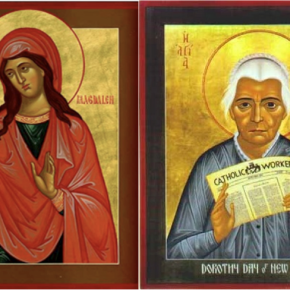
What Mr. Adams gave them was The Gospel According to the Other Mary, a new oratorio based more or less on the Passion and Resurrection of Jesus.  A libretto by Peter Sellars uses a number of contemporary extra-biblical sources (including the writings of Dorothy Day, social activist and co-founder of the Catholic Worker) to supplant portions of the traditional narrative and re-focus the point of view of the story to be that of two women, Mary Magdalene  and Martha.  It is intended as a sort of companion to El Niño, Messers. Adams’s and Sellars’s decade-old oratorio constructed in a similar fashion.

Based on Thursday’s world premiere performance conducted by Gustavo Dudamel, there are other similarities:  both scores have some sparkling choruses, moving arias, and incisive orchestral writing.  More importantly, however, there are key differences, two of which prove troublesome:

Read more of this post

Nothing casual about this Mozart: Kiera Duffy joins Gustavo Dudamel and the LA Phil

It wasn’t supposed to be an all-Mozart program.  What was originally announced as a Tchaikovsky/Sibelius program morphed a couple of times over the course of this season before landing on its final form.  One of the subscribers wasn’t happy about all the repeated changes and made her opinion known during the “Casual Friday” post-concert Q&A.  With a sense of annoyance and exasperation, she asked, “Doesn’t anyone know what’s going on?”

It was an uncomfortable moment.  Luckily, among the panelists on stage taking questions was the person best equipped to provide an answer:  Gustavo Dudamel.  With his good natured style, he made no effort to soft-pedal his response and instead took the question head on.  He explained that the Sibelius 5th Symphony means a great deal to him (he conducted it in his first concert with one of his other orchestras, the Gothenburg Symphony); however,  it made more sense to surround the Los Angeles Philharmonic’s performance of Mozart/DaPonte operas with Mozart Serenades.  Next year, it’ll be The Marriage of Figaro and the Haffner Serenade (though in the currently published version of the LA Phil’s 2012/13 season, it doesn’t show up).  For this year, they settled on pairing Don Giovanni with the Posthorn Serenade.

His style in responding to that question perfectly reflected the style with which he approached the two Mozart works on the program:  good natured but head on.

Read more of this post

Southwest Chamber Music’s promising new festival

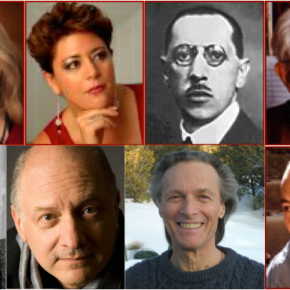
Top Row: Anne LeBaron, Gabriela Ortiz, Igor Stravinsky, Elliott Carter
Bottom Row: Milton Babbitt, Daniel Catan, Peter Lieberson, Vu Nhat Tan

A four-concert event called “The Inaugural LA International New Music Festival” certainly sounds like a big deal.  You can forgive Southwest Chamber Music for giving their nascent new music series such an official, highfalutin’ sounding name.

With the city’s long-standing reputation as an incubator of new music and home to many prominent composers, you’d think an event with such a name would have been created by someone else at some point in the past.  It wasn’t.   You might also assume that it’d receive attention, support, and advanced publicity from the major local paper.  It hasn’t.

You might also think you’d get a mix of living composers from around the globe.  You didn’t — at least not yet.   I’m sure that if Jeff von der Schmidt, Southwest’s Artistic Director, has his way, the Festival will continue to grow in scope and stature, filled with premieres by composers from every continent.  The vast majority of composers consisted of Americans (North and South) and Asians, with world premieres from Korean-American composer Hyo-shin Na and Vietnamese composers Vu Nhat Tân and Tôn Thât Tiêt.  For now, the Old World contingent was represented by Schoenberg and Stravinsky, who I’d consider just as much Angeleno as European.

On Monday night, the third concert of the series featured a collection of compact works for a mix of instruments and voice.  They represented a fairly broad range of musical styles, some more accessible than others, though none of which were particularly thorny relative to the most avant-garde new music or even the works of John Cage which Mr. von der Schmidt so proudly champions.  It ended with a veritable jam session featuring Southwest and guest musicians, utilizing a mix of Western classical music instruments, traditional Vietnamese instruments, and electronic enhancements.  The whole experience was fascinating and rewarding, and made me wish I could have attended the previous two concerts.

Read more of this post

Go big or go home: an ambitious Don Giovanni staged by the Los Angeles Philharmonic

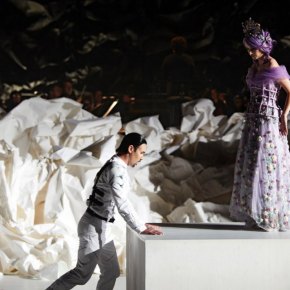
It was not your average Sunday afternoon at Walt Disney Disney Concert Hall.  Gustavo Dudamel was still on the podium for the Los Angeles Philharmonic’s unofficial Mozart Month, but that was pretty much where “business as usual” ended.  The LA Phil had decided that their first-ever complete performances of Don Giovanni would be full-blown productions, not mere stand-and-sing concert versions of Mozart’s opera.

As if that weren’t enough, they:

  • hired Frank Gehry, the designer of Disney Hall and most famous living architect on the planet,  to create the setting
  • populated it with a young, attractive, and vocally strong cast led by Mariusz Kwiecien, one of the most prominent Dons currently around
  • dressed them in costumes designed by Kate and Laura Mulleavy of the noteworthy Los Angeles fashion house, Rodarte
  • handed the whole thing over to Christopher Alden, a director known locally for interesting operatic interpretations

The result was high in style and substance, sounding very good and looking stunning.  It wasn’t a complete triumph, with some aspects which were quirky and frustrating, but you had to appreciate and be impressed by the overall effort. Read more of this post

%d bloggers like this: